




-
鄂尔多斯盆地东南部上古生界石炭系—二叠系蕴含丰富的煤系天然气资源,发育一套海相、海陆过渡相、陆相的含煤碎屑岩沉积[1⁃2],地层的精细划分是地质研究的基础,在天然气资源评价及勘探开发应用中至关重要。对于太原组—山西组的分界,由于地层划分方式和研究方向不同,造成了一定的争议,这对鄂尔多斯盆地石炭系—二叠系太原组和山西组的划分造成了一定的困扰。关于山西组与下伏太原组的划分对比,在岩石地层学研究中,前人普遍将“北岔沟砂岩”的底界作为二者的界线,并以北岔沟砂岩之上发育的4#、5#煤层组作为辅助标志[3⁃7];在层序地层学研究中,以地震反射界面SS3底界区域性海退面作为太原组顶界或者山西组底界,并且以山西组4#、3#煤层的强反射作为辅助标志划分[8⁃9];在生物地层学研究中,以太原组层位最高的牙形类化石带牙行类Streptognathodus iso-latus带作为顶界标志划分[10⁃13];最新年代学研究表明,太原组持续时间从晚格舍尔期至早阿瑟尔期,即303.7±0.1 Ma~295.9±0.15 Ma[13]。
对于太原组顶部的一套海相砂泥岩层,前人将其归为太原组[14⁃17];而在近期海陆过渡相煤系天然气勘探开发研究中部分学者则将东大窑灰岩作为太原组的顶界岩层,而将东大窑灰岩上覆的海相砂泥岩层划归到山西组[18⁃19]。这使得鄂尔多斯盆地太原组—山西组的地层界限出现争议,仅根据地层的沉积特征和植物化石等证据难以解决太原组顶部这套海相砂泥岩层的沉积年代争议。
碎屑锆石U-Pb年代学的基本原理是利用放射性地质年代学来测定沉积岩中具有代表性碎屑矿物锆石的年代,被广泛用于约束沉积地层时代[20⁃27],目前由于在研究区具争议层段发现了大量含煤系天然气,在油气资源勘探研究方面,对其地层的精细划分是非常重要的。因此,本文基于前人的地层划分方案,对研究区太原组—山西组界线周围过渡层段采样,通过碎屑锆石U-Pb年代学研究进行岩石地层的地质年龄约束,从而解决研究区太原组顶部海相砂泥岩层的沉积年代争议。
-
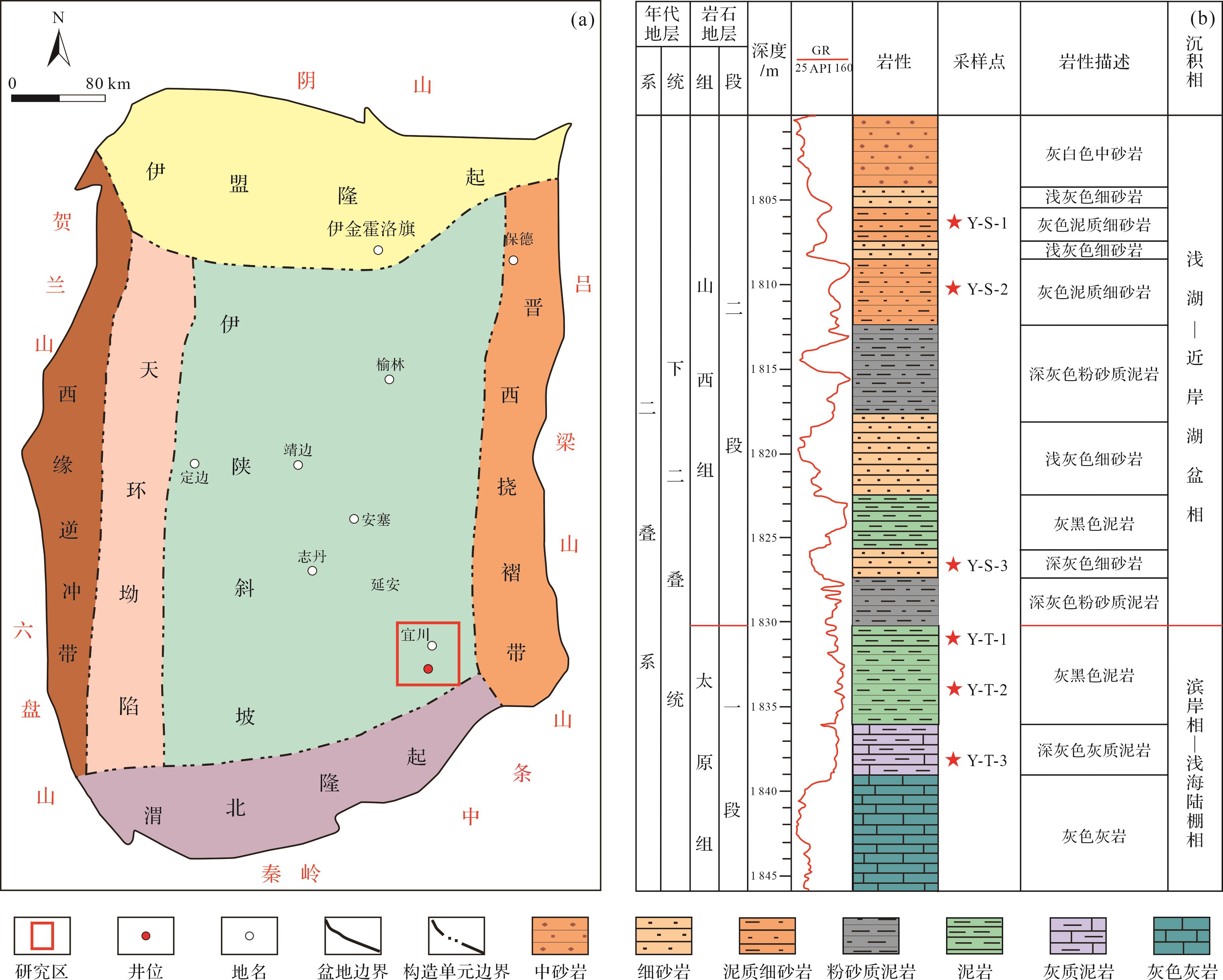
研究区位于鄂尔多斯盆地东南部,构造单元属于伊陕斜坡(图1),其上古生界二叠纪沉积建造经历了由陆表海到河流三角洲沉积的转变[28⁃31]。在早二叠世太原组沉积时期,盆地北部由于兴蒙海槽的关闭,形成北高南低的地势特征,伴随着东西两侧华北海和祁连海的持续侵入,鄂尔多斯盆地整体发育滨浅海沉积[31],研究区则为浅海陆棚沉积,发育小型障壁岛,由于沉积速率低,补偿慢,因此沉积厚度较小,形成了上部为暗色粉砂岩与泥岩互层, 下部为灰岩的岩性特征。

图 1 研究区位置及采样位置图
Figure 1. Map of the study area and the sampling location
在中二叠世山西组沉积时期华北板块北缘迅速隆升,导致鄂尔多斯盆地南北沉积格局分异增强,盆地经历了一次由海到陆的沧桑变化,进入近海内陆坳陷沉积阶段。鄂尔多斯盆地发育滨浅湖和三角洲沉积[31],研究区则表现为浅湖—近岸湖盆沉积,山西组底部在一定程度上仍然继承了太原组的沉积相,山西组中部以及上部已经过渡为陆相沉积,形成了下部为砂泥岩互层,中部为细砂岩,上部为中砂岩的岩性特征。
-
依据前人划分方案[3],在研究区内的取心井宜120井中(图1),分别选取太原组顶部海相砂泥岩、山西组底部砂岩的钻井岩心样品总计80 kg,制得样品共6件(采样位置见图1b,样品编号及采样层位见表1),并对所采样品进行了薄片镜下鉴定以及碎屑锆石U-Pb年龄测定。
表 1 宜川地区太原组—山西组碎屑锆石样品描述
Table 1. Description of crushed zircon samples of the Taiyuan Formation⁃Shanxi Formation in the Yichuan area
样品编号 采样层位 采样深度/m 岩性描述 Y-T-1 太原组 1 831.64~1 833.17 深灰色泥质细粉砂岩 Y-T-2 太原组 1 834.64~1 836.97 黑色泥质细粉砂岩 Y-T-3 太原组 1 838.39~1 840.54 黑色泥岩 Y-S-1 山西组 1 806.50~1 808.18 浅灰色细砂岩、灰白色中砂岩 Y-S-2 山西组 1 809.39~1 812.80 浅灰色细中粒砂岩 Y-S-3 山西组 1 827.80~1 830.22 深灰色极细粒砂岩、灰黑色泥岩 样品在河北省廊坊地质大队进行破碎、淘洗、锆石挑选等处理步骤。为满足样品数量需求,每个样品挑选出300粒以上的锆石制靶做实验。在西北大学大陆动力学国家重点实验室获得阴极发光显微图像,为符合碎屑锆石数理统计意义[32],每个样品随机挑选120~240粒内部结构均匀或振荡环带明显的碎屑锆石进行试验。
锆石样品U-Pb年龄在西北大学大陆动力学国家重点实验室激光剥蚀—电感耦合等离子质谱仪(LA-ICP-MS)上进行测定,其中激光束斑直径设定为30 µm,频率设定为10 Hz。激光剥蚀过程中用He作为剥蚀物载气,用人工合成硅酸盐玻璃NIST 610使激光剥蚀系统达到最佳效果,以Harvard锆石91500国际标准锆石作为元素分馏效应的外标进行校正[33⁃34]。数据处理采用Glitter 4.0程序,锆石年龄计算以及谐和图的绘制用Isoplot软件完成。本研究通过上述实验步骤及数据处理步骤获得的锆石年龄数据采用锆石年龄直方图、概率密度图(Probability Density Plot,PDP)、核密度估计图(Kernal Density Estimate,KDE)呈现[35⁃36]。
-
本文所采样品的镜下薄片鉴定结果如下:太原组样品(Y-T-1、Y-T-2、Y-T-3)为细粉砂质泥岩、泥岩,山西组样品(Y-S-1、Y-S-2、Y-S-3)主要为中细粒岩屑砂岩。
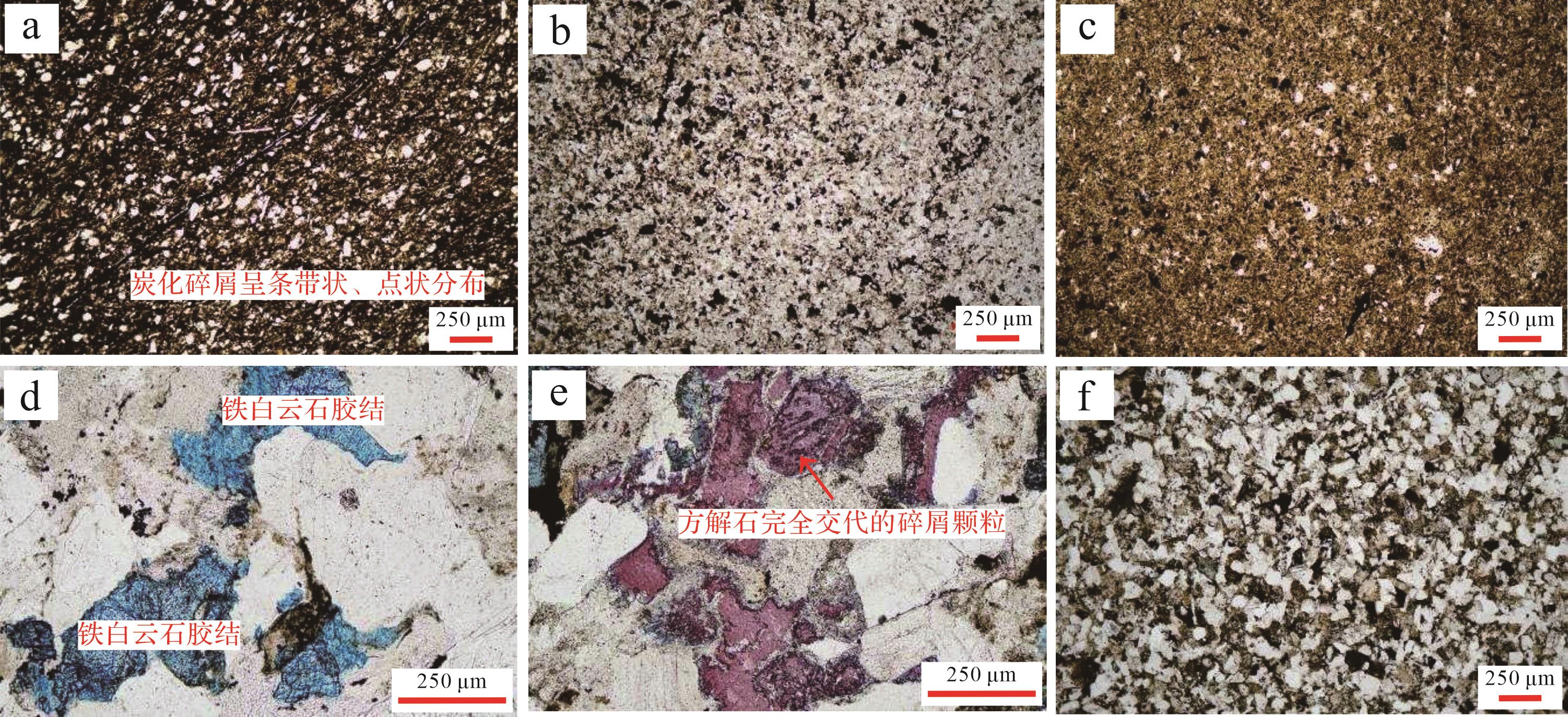
太原组样品岩石学特征:Y-T-1样品为含砂泥岩,含砂泥质结构;岩石颗粒主要为石英,泥质主要由黏土质杂基和泥级碎屑组成;石英颗粒以粉砂级为主,见少量极细粒砂,分选中等,磨圆为次棱角状,呈散乱分布,含量约占17%;在镜下可见明显的呈条带状和点状分布的炭化碎屑(图2a)。Y-T-2样品为泥质细粉砂岩,细粉砂质结构;岩石成分主要由粉砂级石英颗粒、泥质组成;石英颗粒以细粉砂为主,见少量粗粉砂,偶见极细粒砂,分选中等,磨圆为次棱角状,含量约占67%,泥质主要为黏土质杂基,含量约占30%(图2b)。Y-T-3样品为泥岩,泥质结构;岩石成分主要为泥质、粉砂级石英颗粒;泥质成分主要由黏土质杂基、泥级碎屑颗粒组成,石英颗粒以细粉砂级为主,偶见粗粉砂,粒径主要介于0.01~0.03 mm,分选好,磨圆为次棱角状,呈星散状分布,含量约为3%(图2c)。

图 2 宜120井太原组—山西组岩石显微镜照片
Figure 2. Photomicrographs of Taiyuan Formation⁃Shanxi Formation in well Yi 120
山西组样品岩石学特征:Y-S-1样品为中细粒岩屑砂岩,以中细粒砂质结构为主;岩石颗粒主要为石英、岩屑,含少量斜长石。薄片经茜素红和铁氰化钾3∶2混合剂染色后,在单偏光镜下有明显呈蓝色的铁方解石胶结(图2d)。Y-S-2样品为细中粒岩屑砂岩,以细中粒砂质结构为主;岩石颗粒主要为石英、岩屑,含少量斜长石。薄片染色后,在单偏光镜下可见呈紫色的钙质碎屑(图2e)。Y-S-3样品为极细粒碎屑砂岩,以极细粒砂状结构为主;见细粒砂,少量粗粒砂;岩石颗粒主要为石英、岩屑,含少量长石(图2f)。
-
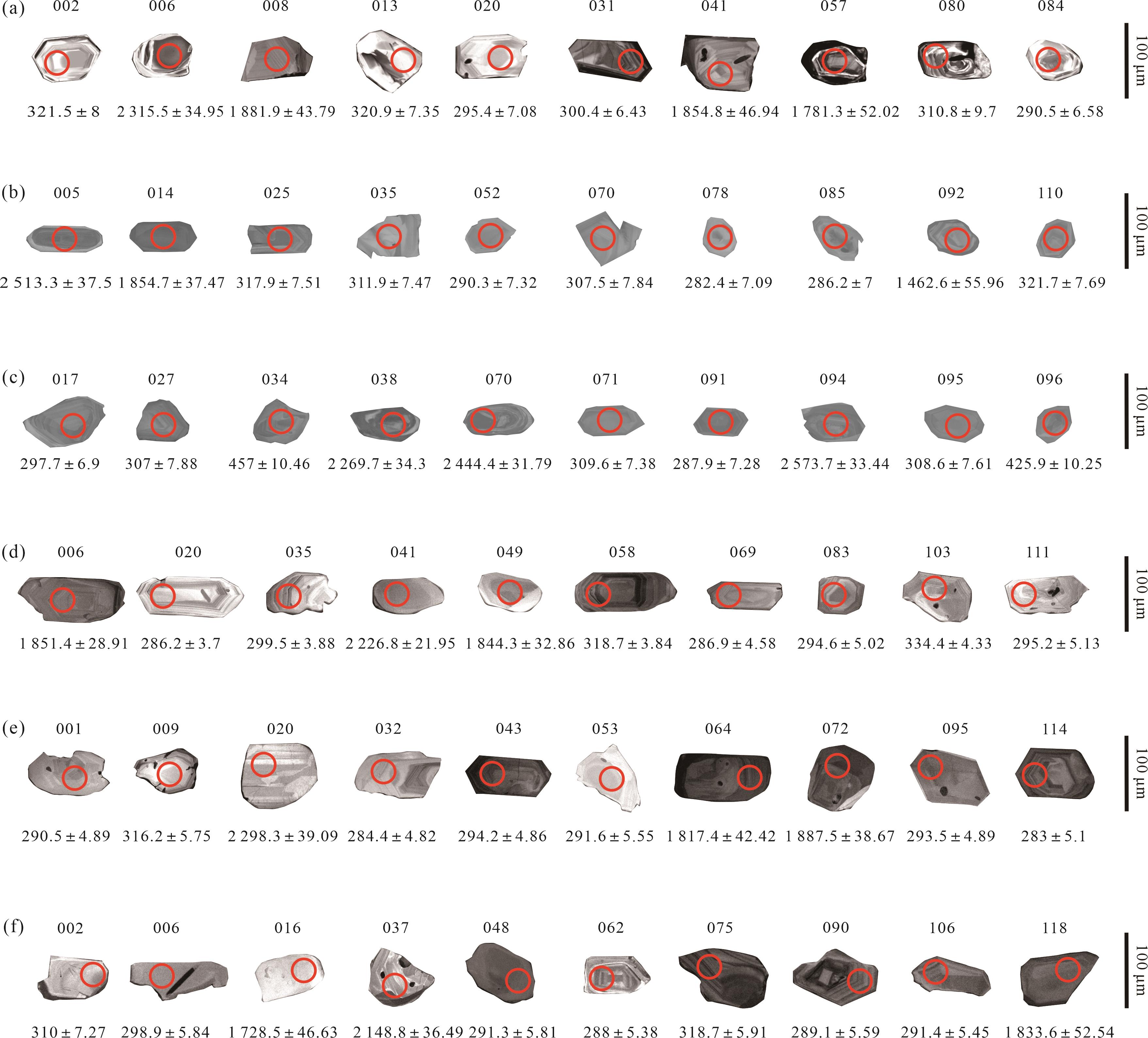
样品中的碎屑锆石颗粒粒径介于50~100 μm(图3),锆石大多数显褐色,且具有明显的振荡环带。锆石内部结构、形态和Th/U比值能够反映锆石成因[37],研究区样品中锆石外形大多数为尖棱状,少数为次棱柱状且锆石基本具有明显的振荡环带结构,反映锆石颗粒经历了近距离的搬运磨蚀,为岩浆成因锆石,并且研究区锆石样品中Th/U比值基本大于0.4,最终认为样品中大部分锆石为岩浆锆石[38]。

图 3 鄂尔多斯盆地宜川地区太原组—山西组代表性碎屑锆石阴极发光图像
Figure 3. Representative image of zircons from the Taiyuan Formation⁃Shanxi Formation in the Yichuan area, Ordos Basin
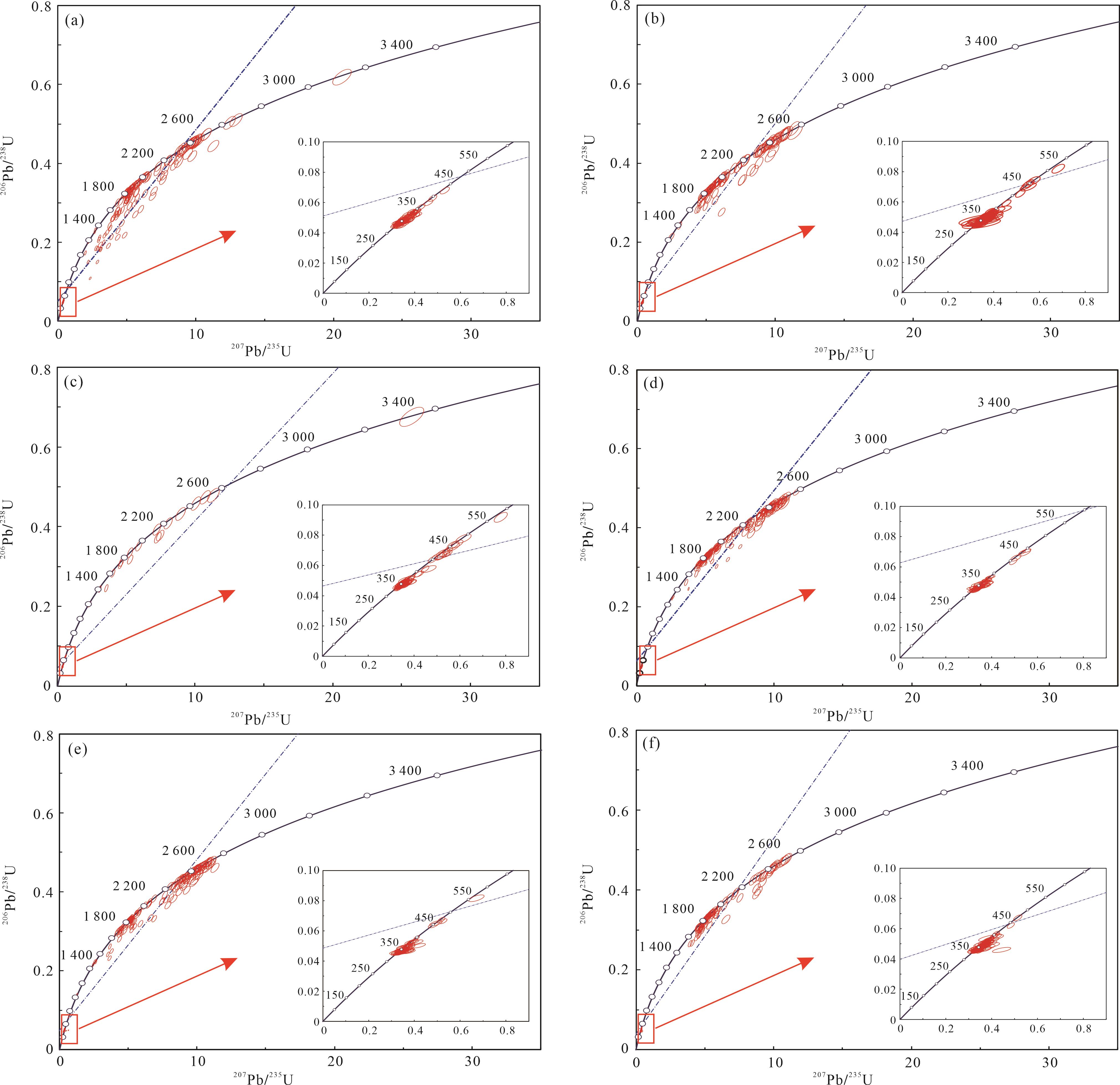
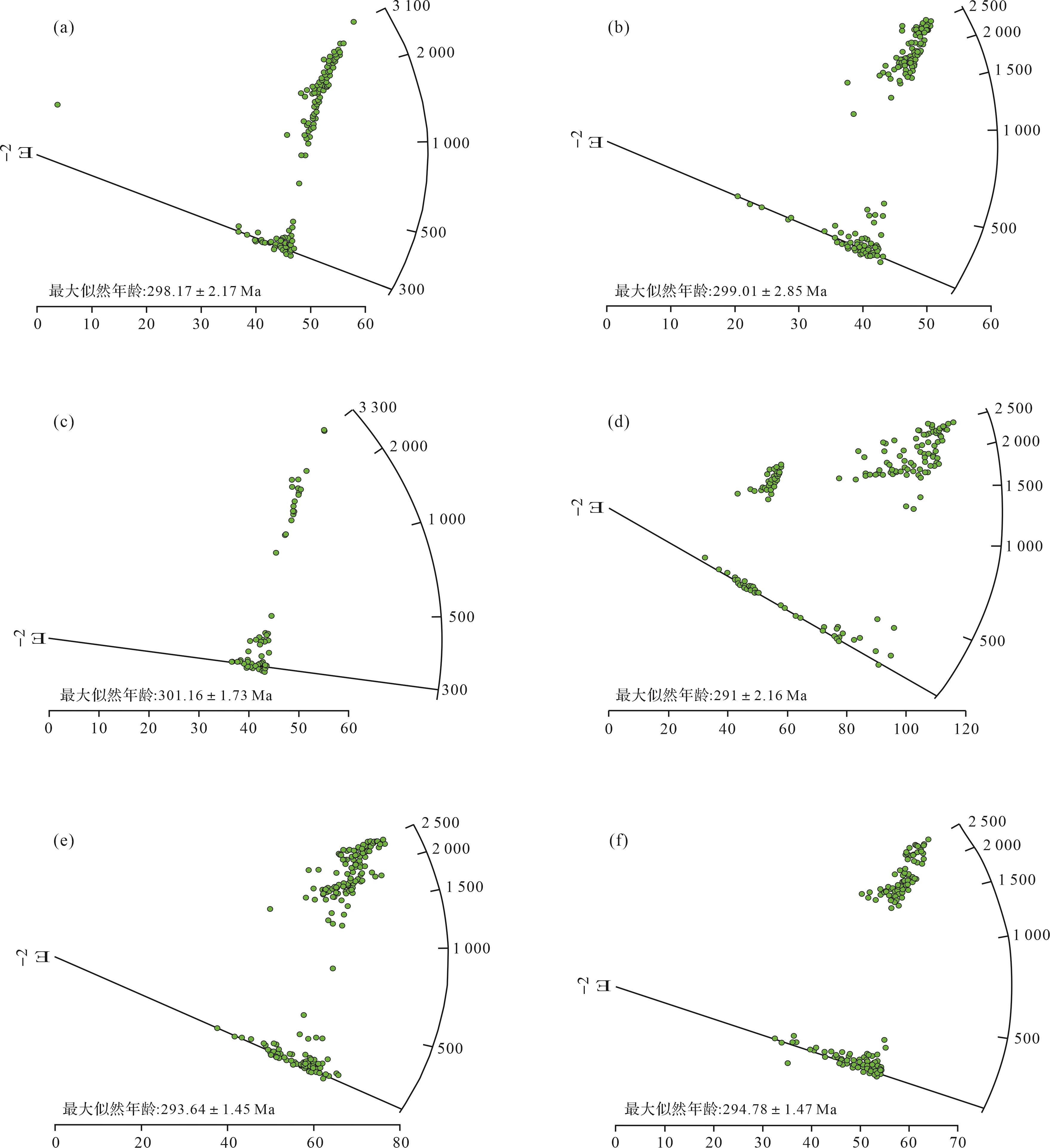
古老锆石(>1 000 Ma)部分颗粒存在一定程度的铅丢失现象(图4),在年龄数据协和的基础上,对于大于1 000 Ma的锆石颗粒采用207Pb/206Pb比值年龄,而小于1 000 Ma的锆石颗粒采用206Pb/238U比值年龄[39]。

图 4 宜川地区太原组—山西组碎屑锆石U⁃Pb年龄谐和图
Figure 4. U⁃Pb concordia plot for detrital zircon from the Taiyuan Formation⁃Shanxi Formation clastic rocks in the Yichuan area
-
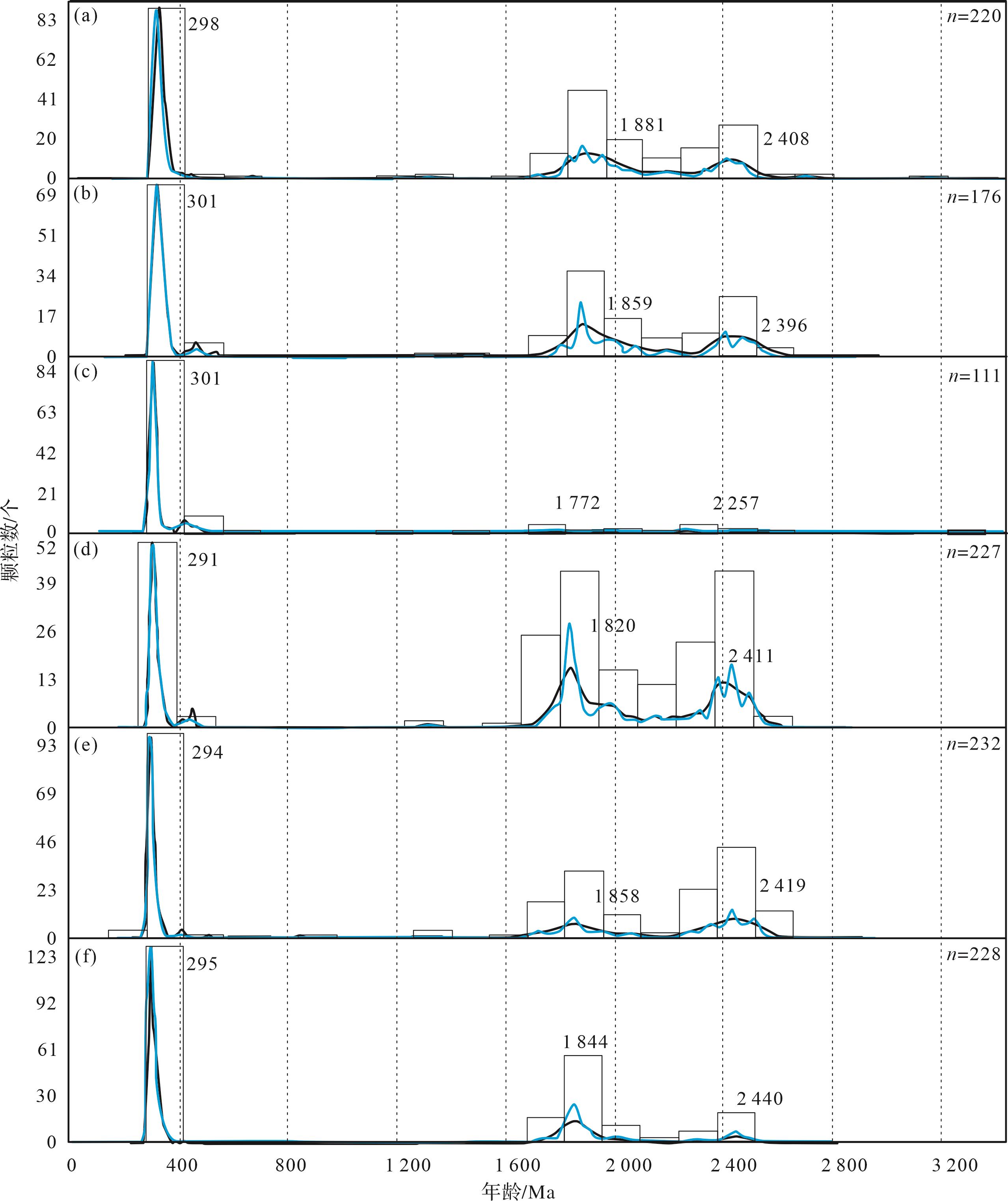
太原组Y-T-1样品中共获得220个有效谐和年龄数据,年龄数据主要分为280~363 Ma、1 808~2 050 Ma、2 335~2 692 Ma三个年龄区间(图5),有1颗3 132 Ma的锆石来自太古宙,年龄谱中显示有298 Ma的主峰值年龄和1 881 Ma、2 408 Ma的次峰值年龄;Y-T-2样品中共获得176个有效谐和年龄数据,年龄数据主要集中在282~508 Ma、1 282~2 072 Ma、2 102~2 588 Ma三个年龄区间(图5),年龄谱中显示有301 Ma的主峰值年龄和1 859 Ma、2 396 Ma的次峰值年龄;Y-T-3样品中共获得111个有效谐和年龄数据,年龄数据主要分布在283~567 Ma、1 254~2 574 Ma两个年龄区间(图5),年龄谱中显示有301 Ma的主峰值年龄和1 772 Ma、2 257 Ma的次峰值年龄。

图 5 宜川地区太原组—山西组碎屑锆石U⁃Pb年龄分布图
Figure 5. Distribution of detrital zircon U⁃Pb ages from the samples of the Taiyuan Formation⁃Shanxi Formation in the Yichuan area
-
山西组Y-S-1样品中共获得227个有效谐和年龄数据,年龄数据主要分布在280~343 Ma、1 299~2 043 Ma、2 054~2 578 Ma三个年龄区间(图5),年龄谱中显示291 Ma的主峰值年龄和1 820 Ma、2 411 Ma的次峰值年龄;Y-S-2样品中共获得232个有效谐和年龄数据,年龄数据主要分布在283~364 Ma、1 611~2 068 Ma、2 113~2 578 Ma三个年龄区间(图5),年龄谱中显示294 Ma的主峰值年龄和1 858 Ma、2 419 Ma的次峰值年龄;Y-S-3样品中共获得228个有效谐和年龄数据,年龄数据主要集中在283~388 Ma、1 721~2 489 Ma、2 504~2 520 Ma三个年龄区间内(图5),年龄谱中显示295 Ma的主峰年龄峰值和1 844 Ma、2 440 Ma的次峰年龄峰值。
-
近年来,随着测试技术的发展,碎屑锆石U-Pb年代学方法已经成为建立或者完善年代地层框架的一种流行技术[40⁃42]。尤其是在生物地层控制有限或者是没有可靠火山灰的情况下,碎屑锆石U-Pb定年是确定地层最大沉积年龄的有效方法。碎屑锆石最大沉积年龄具有准确估计取样地层真实沉积年龄(True Depositional Age,TDA)的潜力,随着这项技术的应用完善[43⁃46],产生了很多最大沉积年龄的估算方法,目前常用方法包括最年轻单粒锆石法(Youngest Single Grain Age,YSG)、最年轻频率峰值法(Youngest Graphical Age Peak,YPP)、加权平均年龄法包括(youngest 1σ grain cluster,YC1σ(2+))、(youngest 2σ grain cluster,YC2σ(3+))、最年轻碎屑锆石法(Youngest Detrital Zircon Age,YDZ)、TuffZirc 6+法、τ法等[47⁃49]。其中Vermeesch[50]通过对比这些估算方法重新审视了地层最大沉积年龄方法的准确性,并提出对于样本量的增加,地层最大沉积年龄估计值会越来越小,这个问题可以通过最大似然年龄算法收敛来解决,表明通过最大似然年龄可以更加准确地恢复地层最大沉积年龄。最大似然年龄法是由Galbraith et al.[51]基于极大似然估计引入了适用于U-Pb年代学的最小年龄估计模型,为避免与地层最大沉积年龄产生混淆,故命名为最大似然年龄。本文综合几种地层最大沉积年龄和最大似然年龄讨论宜川地区研究层段的沉积年龄。
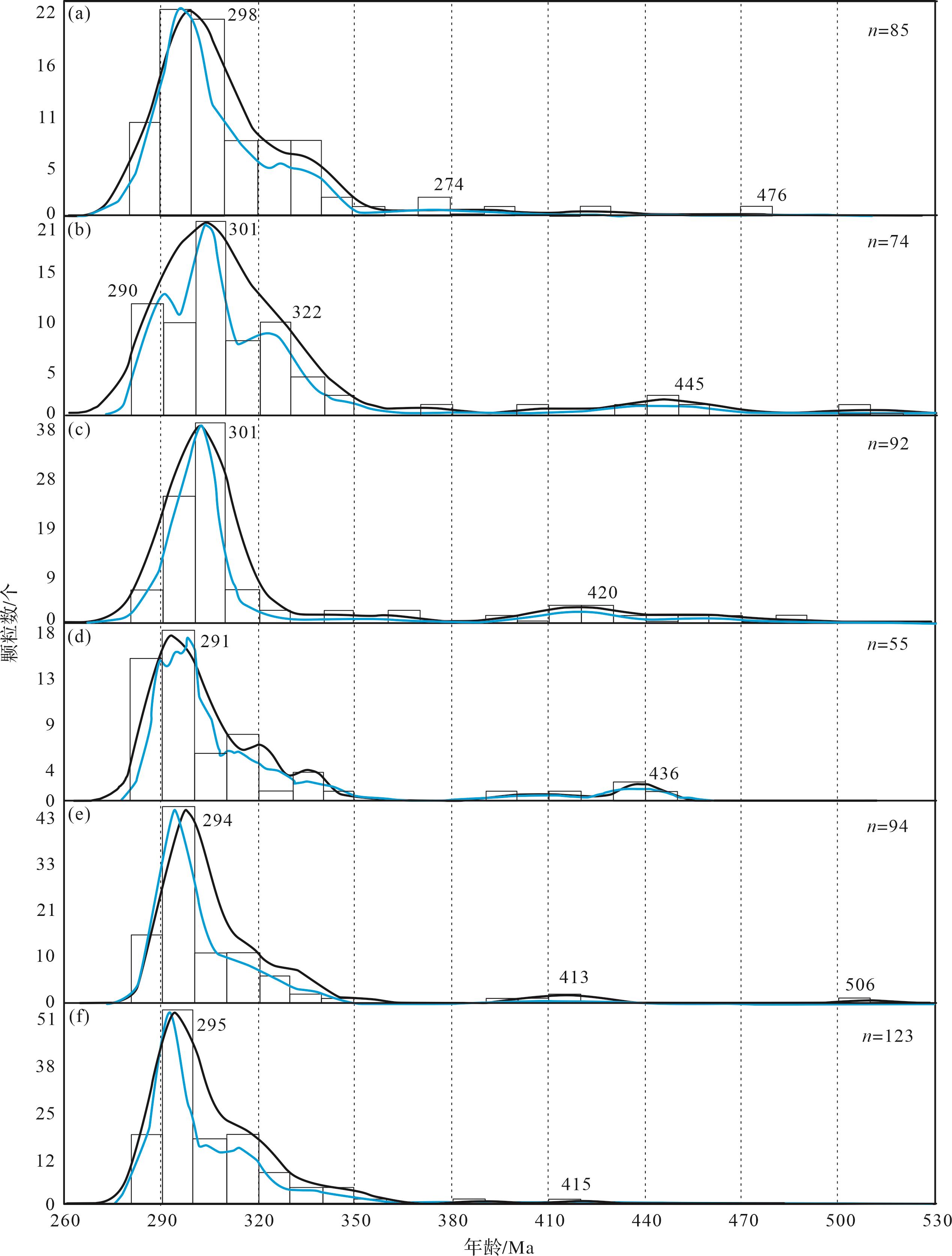
借助样品锆石年龄对于研究区内太原组顶部地层归属的约束,关注的年龄范围集中在石炭纪晚期—早二叠纪。因此,对样品显生宙碎屑锆石进行分析讨论,并绘制了研究区显生宙碎屑年龄分布图(图6)。从图中可以看出,太原组三个样品(Y-T-1、Y-T-2和Y-T-3)中分别给出了298 Ma、301 Ma、301 Ma的YPP年龄;山西组三个样品(Y-S-1、Y-S-2和Y-S-3)中分别给出了291 Ma、294 Ma、295 Ma的YPP年龄。对于显生宙锆石集群,此次研究还采用了YSG年龄、YC1σ(2+)年龄、YC2σ(3+)年龄(表2)。为消除样品规模的增加对最大沉积年龄估计值的影响,各个样品采用最大似然算法收敛得到最大似然年龄值(图7),其中太原组三个样品的MLA年龄分别为298±2 Ma、299±3 Ma、301±2 Ma;山西组三个样品MLA年龄分别为291±2 Ma、294±1 Ma、295±1 Ma。

图 6 宜川地区太原组—山西组显生宙碎屑锆石U⁃Pb年龄分布图
Figure 6. Distribution of Phanerozoic detrital zircon U⁃Pb ages from the samples of the Taiyuan Formation⁃Shanxi Formation in the Yichuan area
表 2 五种方法计算的宜川地区太原组—山西组样品锆石最年轻碎屑锆石年龄对比(据文献[50])
Table 2. Age comparisons of the youngest detrital zircon samples from the Taiyuan Formation⁃Shanxi Formation clastic rocks in the Yi Chuan area calculated using 5 metrics (after reference [50] )
样品编号 采样层位 YSG/Ma YPP/Ma YC1σ(2+)/Ma YC2σ(3+)/Ma MLA/Ma Y-T-1 太原组 280±6 298 286±4 290±4 298±2 Y-T-2 太原组 282±7 301 286±4 291±5 299±3 Y-T-3 太原组 283±7 301 289±4 292±4 301±2 Y-S-1 山西组 281±6 291 286±3 289±3 291±2 Y-S-2 山西组 283±5 294 286±3 288±3 294±1 Y-S-3 山西组 284±5 295 286±3 288±3 295±1 
通过分析上述太原组和山西组样品的各类年龄值可以看出,研究区太原组YSG年龄较上覆山西组YSG年龄小,且Dickinson et al.[20]和Tucker et al.[25]表明用YSG年龄来代表地层最大沉积年龄时存在很大的不准确性,需要其他数据的支撑,因此本文仅用YSG年龄并不能限定研究区的地层最大沉积年龄;另一方面,山西组底部样品的YC1σ(2+)年龄和YC2σ(3+)年龄未构成连续的年龄谱,YC1σ(2+)年龄不同采样位置年龄一致,而YC2σ(3+)年龄上部采样位置的年龄老于下部采样位置的年龄,因此YC1σ(2+)年龄和YC2σ(3+)年龄只能代表物源的最年轻年龄而不能限定沉积时限。研究区太原组Y-T-2和Y-T-3样品的YPP年龄相同,对于地层沉积年龄的约束较MLA年龄说服力较弱,而且由于实验样品的锆石数量较多,MLA年龄数据更具有代表性。因此,本文采用MLA年龄来限定太原组、山西组的地层最大沉积年龄。
-
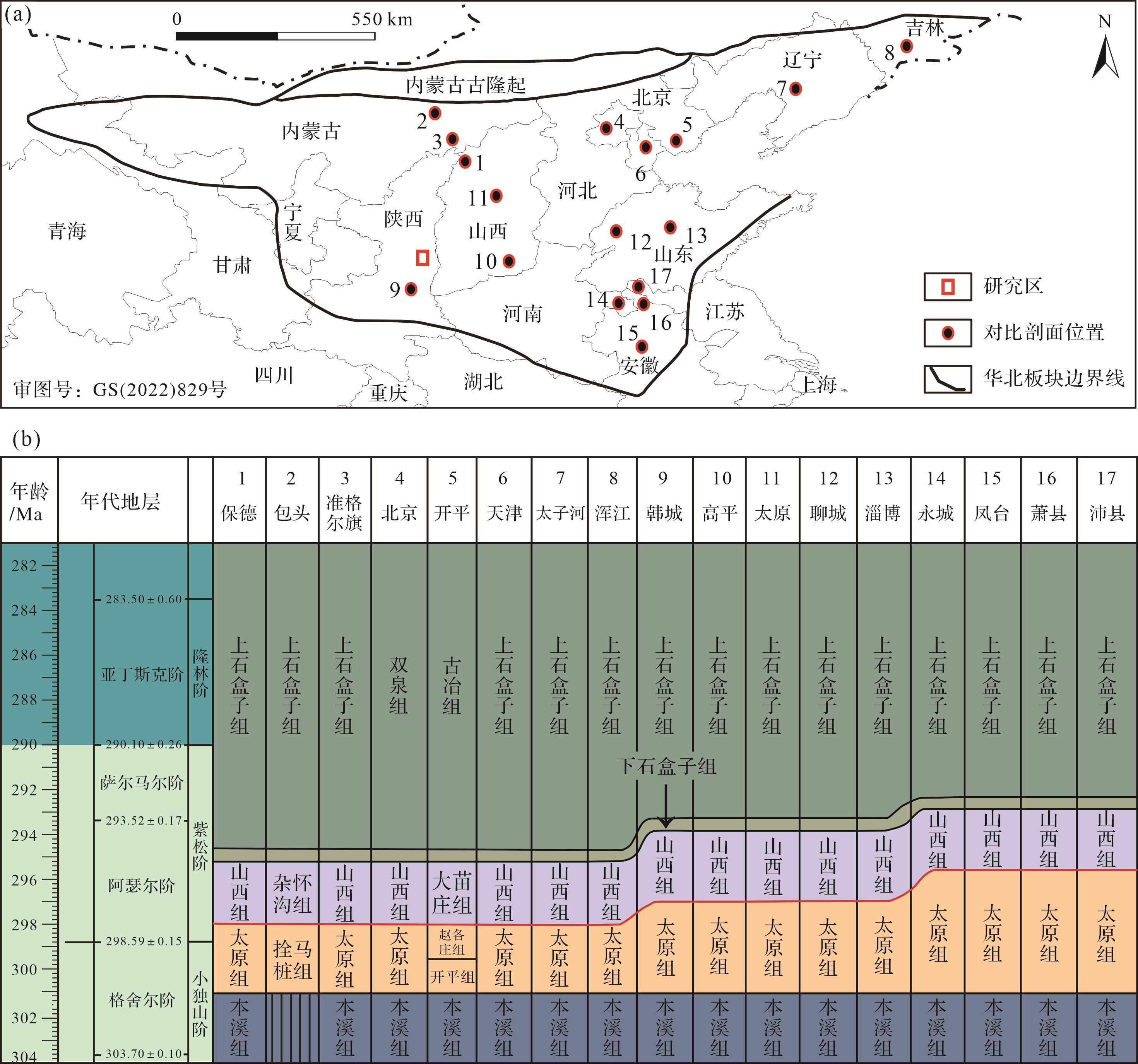
采用MLA年龄为宜川地区的太原组顶部最大沉积年龄,将298±2 Ma作为太原组顶部含砂泥岩的沉积年龄。李洪颜等[23]在山西宁武—静乐盆地获得了太原组顶部砂岩锆石年龄303±4 Ma;Yang et al.[52]在永城盆地获得了太原组顶部更高精度的火山灰锆石年龄295.65±0.08 Ma;Wu et al.[53]在山西保德获得太原组顶界年龄298.18±1.2 Ma;Wang et al.[54]在内蒙古乌海乌达获得了太原组顶部火山灰锆石年龄295.9±1.4 Ma,在同一层火山灰岩中,Schmitz et al.[55]获得了298.34±0.09 Ma的年龄;Yang et al.[56]在北京西山获得的太原组最年轻碎屑锆石年龄为304±3 Ma。基于上述对于华北地区太原组—山西组锆石定年的统计(表3)绘制了华北板块地层划分对比图(图8),发现对于整个华北板块,其太原组—山西组界线的年龄自北向南,呈现从老到新的变化趋势,这与二叠纪华北板块的海退方向相同,上述高精度定年指示华北板块太原组顶界时代属于早—中阿瑟尔时期。研究区大致位于华北板块中部,上述年龄可以为研究区太原组顶部的锆石年龄对比提供依据。
表 3 华北板块二叠纪太原组—山西组锆石年龄汇总
Table 3. Age summary of Permian zircon in the Taiyuan Formation⁃Shanxi Formation in North China Plate
区域 采样层位 锆石类型 年龄/Ma 测试方法 甘肃平凉 山西组 碎屑锆石 281±4 LA-ICP-MS 山西阳城 山西组底部 碎屑锆石 299 LA-ICP-MS 山西太原 太原组上部 碎屑锆石 295 LA-ICP-MS 山西宁武 太原组顶部 碎屑锆石 303~320 LA-ICP-MS 山西保德 太原组顶部 火山灰锆石 298.18±0.32 ID-TIMS 内蒙古乌海乌达 太原组顶部 火山灰锆石 295.9±1.4 SIMS 内蒙古乌海乌达 太原组顶部 火山灰锆石 295.9±1.4 ID-TIMS 河南永城 太原组顶部 火山灰锆石 295.56±0.08 LA-ICP-MS 北京西山 太原组 砂岩 304±3 LA-ICP-MS 
图 8 华北板块上石炭统本溪组—下二叠统上石盒子组划分和对比
Figure 8. Upper Carboniferous Benxi Formation⁃Lower Permian Upper Shihezi Formation stratigraphic division and correlation of the North China Plate
采用研究区太原组MLA年龄298±2 Ma作为太原组顶部海相砂泥岩的沉积年龄,其与上述太原组顶界年龄值差异较小,并与早阿瑟尔期地质年代相一致[58]。在早阿瑟尔期出现全球性海退,鄂尔多斯盆地也发生大规模海退,其古地理格局也从陆表海变为利于植物生长的三角洲和潮坪环境[59⁃60],与此同时,鄂尔多斯盆地发生了华夏植物群辐射事件[61⁃62],形成了大规模的热带雨林系统[63]。研究区于阿瑟尔晚期处于浅海陆棚相沉积,水动力以波浪和海流为主,沉积物以粉砂和泥为主。温暖的古气候条件和优质的有机质供给,导致该层段发育一套暗色泥岩、含泥质粉砂岩。由于海退时间较短,温暖湿润的成煤期很短,不能完全发育煤层,因此该段地层的岩性以暗色泥岩为特征,从而为煤系天然气提供良好的生储条件,这为太原组顶部发现有含煤系天然气提供了一定的依据。因此,本文所获得的太原组顶部MLA年龄同样可以作为研究区太原组顶部海陆过渡相含煤系天然气砂泥岩形成的时间。
-
采用MLA年龄为宜川地区的山西组底部最大沉积年龄,将295±1.0 Ma作为山西组底部砂岩的沉积年龄。罗顺社等[64]在鄂尔多斯盆地西南部甘肃庆阳获得了山西组山一段砂岩287±3.7 Ma的碎屑锆石年龄;Sun et al.[65]在甘肃平凉获得了山西组最年轻碎屑锆石年龄281±4.0 Ma;Zhu et al.[66]在山西阳城获得了山西组底部砂岩的299 Ma的碎屑锆石年龄;Yang et al.[52,67]和Wu et al.[68]对华北板块太原组顶界进行测年,获得华北板块南部和北部山西组底界年龄分别为295.65±0.08 Ma和298.18±0.32 Ma,并获得对应层位火山灰锆石年龄和植物化石、孢粉化石的验证。基于华北板块太原组—山西组界线年龄的变化趋势(图8)和上述学者所获得的年龄的验证,本文提出的山西组底部最大沉积年龄是具有参考价值的,对于研究区太原组—山西组分界具有一定的指示意义。申傅恒等[13]总结了最新的华北板块石炭纪—二叠纪地层时间框架,认为山西组的时代属于中—晚阿瑟尔期。中阿瑟尔期由于古气候出现季节性干热[69],由于受海退影响和古气候的季节性变化,使得一些植物物种灭绝,热带雨林面积减少[70⁃71],由此山西组底部煤层发育受到抑制,但是部分地区仍以河流三角洲沉积为主,体现为砂泥岩互层沉积,而研究区为浅湖—近岸湖盆沉积,发育一系列细粒、极细粒含碎屑砂岩,含泥砂岩和泥岩。
-
(1) 鄂尔多斯盆地南部宜川地区上古生界太原组顶部泥岩的最大沉积年龄为298±2 Ma;山西组底部砂岩的最大沉积年龄为295±1 Ma。
(2) 通过对比其最大沉积年龄与华北板块石炭纪—二叠纪地层时间框架,结合相应沉积期古环境演化形成的沉积岩性特征,认为鄂尔多斯盆地东南部宜川地区上古生界太原组—山西组过渡层段的海相砂泥岩层应归属于太原组。在海陆过渡相页岩气勘探理论研究时,将太原组顶部海相砂泥岩提至山西组应谨慎考虑,避免造成争议。
Determination of the Top Boundary Strata of the Taiyuan Formation in the Southeastern Ordos Basin:Constrainted by U-Pb geochronology of the Taiyuan Formation-Shanxi Formation in the Yichuan area
-
摘要: 目的 为了重新厘定鄂尔多斯盆地宜川地区石炭系—二叠系太原组和山西组的地层界线,解决太原组—山西组界线附近的含煤系天然气砂泥岩层段的沉积年代归属问题。 方法 选取典型取心井宜120井内太原组与山西组过渡层段砂泥岩样品,进行碎屑锆石U-Pb定年,利用最大沉积年龄(Maximum Depositional Age,MDA)估算方法,结合前人对华北板块太原组—山西组锆石年龄的研究成果,约束研究层段的沉积年龄。 结果 太原组顶部砂泥岩的最大似然年龄(Maximum Likelihood Age,MLA)298±2 Ma代表其地层最晚沉积的年龄,该层段沉积于早阿瑟尔期,与牙形类生物地层确定的阿瑟尔期沉积年代一致;山西组底部砂岩样品的MLA年龄为295±1 Ma,代表了其最早沉积的年龄,该层段沉积于中—晚阿瑟尔期。 结论 研究区太原组—山西组分界线应处于太原组顶部砂泥岩层段之上,即研究区太原组顶部海相砂泥岩层应该属于太原组,这为研究区太原组—山西组的划分提供了一定的依据。Abstract: Objective In this study, to redetermine the stratigraphic boundary of the Carboniferous-Permian Taiyuan Formation and Shanxi Formation in the Yichuan area of the Ordos Basin and to solve the problem of sedimentary age attribution of coal-bearing natural gas mudstone section near the boundary of the Taiyuan Formation-Shanxi Formation. Methods We selected the sandstone and mudstone samples of the transition layer between the Taiyuan Formation and Shanxi Formation in the typical coring well Yi 120 to conduct the U-Pb dating of detrital zircon and we used the maximum depositional age ( MDA ) estimation method, combined with previous research results on the zircon age of the Taiyuan Formation-Shanxi Formation in the North China Plate, to constrain the depositional age of the study interval. Results Experiments show that the maximum likelihood age (MLA) of the sandstone and mudstone at the top of the Taiyuan Formation is 298±2 Ma, which represents the age of the latest deposition of the strata. This interval was deposited in the Early Asselian period, which is consistent with the Asselian sedimentary age determined by conodont. The MLAs of the sandstone samples at the bottom of the Shanxi Formation is 295±1 Ma, representing the age of the earliest deposition, which was deposited in the Middle-Late Arthurian period. Conclusions Based on the above research and analysis, we conclude that the boundary between the Taiyuan Formation and Shanxi Formation in the study area should be above the sand-mudstone section at the top of the Taiyuan Formation; that is, the marine sand-mudstone layer at the top of the Taiyuan Formation in the study area should belong to the Taiyuan Formation, which provides a certain basis for the stratigraphic division of the Taiyuan Formation-Shanxi Formation in the study area.
-
Key words:
- Ordos Basin /
- Taiyuan Formation /
- clastic rocks /
- zircon U-Pb age /
- sequence classification
-
图 2 宜120井太原组—山西组岩石显微镜照片
Figure 2. Photomicrographs of Taiyuan Formation⁃Shanxi Formation in well Yi 120
图 3 鄂尔多斯盆地宜川地区太原组—山西组代表性碎屑锆石阴极发光图像
Figure 3. Representative image of zircons from the Taiyuan Formation⁃Shanxi Formation in the Yichuan area, Ordos Basin
图 4 宜川地区太原组—山西组碎屑锆石U⁃Pb年龄谐和图
Figure 4. U⁃Pb concordia plot for detrital zircon from the Taiyuan Formation⁃Shanxi Formation clastic rocks in the Yichuan area
图 5 宜川地区太原组—山西组碎屑锆石U⁃Pb年龄分布图
Figure 5. Distribution of detrital zircon U⁃Pb ages from the samples of the Taiyuan Formation⁃Shanxi Formation in the Yichuan area
图 6 宜川地区太原组—山西组显生宙碎屑锆石U⁃Pb年龄分布图
Figure 6. Distribution of Phanerozoic detrital zircon U⁃Pb ages from the samples of the Taiyuan Formation⁃Shanxi Formation in the Yichuan area
图 8 华北板块上石炭统本溪组—下二叠统上石盒子组划分和对比
Figure 8. Upper Carboniferous Benxi Formation⁃Lower Permian Upper Shihezi Formation stratigraphic division and correlation of the North China Plate
表 1 宜川地区太原组—山西组碎屑锆石样品描述
Table 1. Description of crushed zircon samples of the Taiyuan Formation⁃Shanxi Formation in the Yichuan area
样品编号 采样层位 采样深度/m 岩性描述 Y-T-1 太原组 1 831.64~1 833.17 深灰色泥质细粉砂岩 Y-T-2 太原组 1 834.64~1 836.97 黑色泥质细粉砂岩 Y-T-3 太原组 1 838.39~1 840.54 黑色泥岩 Y-S-1 山西组 1 806.50~1 808.18 浅灰色细砂岩、灰白色中砂岩 Y-S-2 山西组 1 809.39~1 812.80 浅灰色细中粒砂岩 Y-S-3 山西组 1 827.80~1 830.22 深灰色极细粒砂岩、灰黑色泥岩  下载: 导出CSV
表 2 五种方法计算的宜川地区太原组—山西组样品锆石最年轻碎屑锆石年龄对比(据文献[50])
Table 2. Age comparisons of the youngest detrital zircon samples from the Taiyuan Formation⁃Shanxi Formation clastic rocks in the Yi Chuan area calculated using 5 metrics (after reference [50] )
样品编号 采样层位 YSG/Ma YPP/Ma YC1σ(2+)/Ma YC2σ(3+)/Ma MLA/Ma Y-T-1 太原组 280±6 298 286±4 290±4 298±2 Y-T-2 太原组 282±7 301 286±4 291±5 299±3 Y-T-3 太原组 283±7 301 289±4 292±4 301±2 Y-S-1 山西组 281±6 291 286±3 289±3 291±2 Y-S-2 山西组 283±5 294 286±3 288±3 294±1 Y-S-3 山西组 284±5 295 286±3 288±3 295±1
下载: 导出CSV
表 3 华北板块二叠纪太原组—山西组锆石年龄汇总
Table 3. Age summary of Permian zircon in the Taiyuan Formation⁃Shanxi Formation in North China Plate
区域 采样层位 锆石类型 年龄/Ma 测试方法 甘肃平凉 山西组 碎屑锆石 281±4 LA-ICP-MS 山西阳城 山西组底部 碎屑锆石 299 LA-ICP-MS 山西太原 太原组上部 碎屑锆石 295 LA-ICP-MS 山西宁武 太原组顶部 碎屑锆石 303~320 LA-ICP-MS 山西保德 太原组顶部 火山灰锆石 298.18±0.32 ID-TIMS 内蒙古乌海乌达 太原组顶部 火山灰锆石 295.9±1.4 SIMS 内蒙古乌海乌达 太原组顶部 火山灰锆石 295.9±1.4 ID-TIMS 河南永城 太原组顶部 火山灰锆石 295.56±0.08 LA-ICP-MS 北京西山 太原组 砂岩 304±3 LA-ICP-MS
下载: 导出CSV
-
[1] 师展,赵靖舟,孙雄伟,等. 鄂尔多斯盆地东南部上古生界煤系烃源岩特征及生烃潜力评价[J]. 天然气地球科学,2023,34(9):1612-1626. Shi Zhan, Zhao Jingzhou, Sun Xiongwei, et al. Characteristics and hydrocarbon generation potential of Upper Paleozoic coal measure source rocks in the southeastern Ordos Basin[J]. Natural Gas Geoscience, 2023, 34(9): 1612-1626. [2] 郭艳琴,李文厚,郭彬程,等. 鄂尔多斯盆地沉积体系与古地理演化[J]. 古地理学报,2019,21(2):293-320. Guo Yanqin, Li Wenhou, Guo Bincheng, et al. Sedimentary systems and palaeogeography evolution of Ordos Basin[J]. Journal of Palaeogeography, 2019, 21(2): 293-320. [3] 陈世悦,刘焕杰. 含煤建造露头层序地层分析:以太原西山石炭二叠系剖面为例[J]. 煤田地质与勘探,1995,23(2):13-18. Chen Shiyue, Liu Huanjie. Sequence stratigraphic analysis of coal-bearing formation outcrop: Based on Carboniferous-Permian profile, Xishan, Taiyuan[J]. Coal Geology & Exploration, 1995, 23(2): 13-18. [4] 田雯. 鄂尔多斯盆地东南部二叠系山西组沉积体系研究[D]. 西安:西北大学,2016. Tian Wen. Sedimentary System study of Permian Shaanxi Formation in south-eastern Ordos Basin[D]. Xi’an: Northwest University, 2016. [5] 王岚. 鄂尔多斯西缘地区二叠系太原组、山西组沉积体系研究[D]. 西安:西北大学,2006. Wang Lan. Research on sedimentary system of Permian Taiyuan and Shanxi Formation in western area of Ordos Basin[D]. Xi’an: Northwest University, 2006. [6] 王若谷,周进松,杜永慧,等. 鄂尔多斯盆地东南部延安气田石炭系—二叠系沉积演化模式[J]. 地质科学,2021,56(4):1088-1105. Wang Ruogu, Zhou Jinsong, Du Yonghui, et al. Deposition evolution model of the Carboniferous-Permian in Yan'an gas field, the southeastern Ordos Basin[J]. Chinese Journal of Geology, 2021, 56(4): 1088-1105. [7] 于波. 鄂尔多斯东南部上古生界层序地层特征[J]. 西北地质,2016,49(1):92-100. Yu Bo. Characteristic of Upper Paleozoic sequence stratigraphy in east-southern Ordos Basin[J]. Northwestern Geology, 2016, 49(1): 92-100. [8] 付锁堂. 鄂尔多斯盆地北部上古生界沉积体系及砂体展布规律研究[D]. 成都:成都理工大学,2005. Fu Suotang. The study on the depositional system and sand body spreading regularity of Upper Paleozoic in north Ordos Basin[D]. Chengdu: Chengdu University of Technology, 2005. [9] 付超,于兴河,李顺利,等. 鄂尔多斯盆地东南部晚古生代陆表海层序演化过程与其控制下的聚煤模式[J]. 沉积学报,2023,41(5):1598-1608. Fu Chao, Yu Xinghe, Li Shunli, et al. Stratigraphic sequence evolution in southeastern Ordos Basin and coal accumulation pattern in an epicontinental sea basin[J]. Acta Sedimentologica Sinica, 2023, 41(5): 1598-1608. [10] 高莲凤,丁惠,万晓樵. 豫淮盆地太原组顶部斯威特刺(Sweetognathus)种的分类修正及其地层意义[J]. 微体古生物学报,2005,22(4):370-382. Gao Lianfeng, Ding Hui, Wan Xiao-qiao. Taxonomic revision of conodont Sweetognathus species in the uppermost Taiyuan Formation, Yuhuai Basin and its significance[J]. Acta Micropalaeontologica Sinica, 2005, 22(4): 370-382. [11] 沈树忠,张华,张以春,等. 中国二叠纪综合地层和时间框架[J]. 中国科学:地球科学,2019,49(1):160-193. Shen Shuzhong, Zhang Hua, Zhang Yichun, et al. Permian integrative stratigraphy and timescale of China[J]. Science China Earth Science, 2019, 49(1): 160-193. [12] 沈树忠,徐海鹏,袁东勋,等. 中国二叠纪地层及标志化石图集[M]. 杭州:浙江大学出版社,2020. Shen Shuzhong, Xu Haipeng, Yuan Dongxun, et al. Permian stratigraphy and index fossils of China[M]. Hangzhou: Zhejiang University Press, 2020. [13] 申博恒,沈树忠,吴琼,等. 华北板块石炭纪—二叠纪地层时间框架[J]. 中国科学:地球科学,2022,52(7):1181-1212. Shen Boheng, Shen Shuzhong, Wu Qiong, et al. Carboniferous and Permian integrative stratigraphy and timescale of North China Block[J]. Science China Earth Science, 2022, 52(7): 1181-1212. [14] 董国栋,刘新社,裴文超,等. 鄂尔多斯盆地二叠系太原组致密灰岩储层特征及主控因素[J]. 天然气地球科学,2023,34(6):1018-1027. Dong Guodong, Liu Xinshe, Pei Wenchao, et al. Characteristics and main controlling factors of tight limestone reservoir in Taiyuan Formation of Ordos Basin[J]. Natural Gas Geoscience, 2023, 34(6): 1018-1027. [15] 郭旭升,周德华,赵培荣,等. 鄂尔多斯盆地石炭系—二叠系煤系非常规天然气勘探开发进展与攻关方向[J]. 石油与天然气地质,2022,43(5):1013-1023. Guo Xusheng, Zhou Dehua, Zhao Peirong, et al. Progresses and directions of unconventional natural gas exploration and development in the Carboniferous-Permian coal measure strata, Ordos Basin[J]. Petroleum and Gas Geology, 2022, 43(5): 1013-1023. [16] 王小洪,刘大锰,姚艳斌,等. 鄂尔多斯韩城地区石炭—二叠系含煤沉积体系及其控气作用[J]. 石油实验地质,2013,35(6):646-650. Wang Xiaohong, Liu Dameng, Yao Yanbin, et al. Carboniferous-Permian coal-bearing depositional system and its controlling role of coalbed methane in Hancheng area in Ordos Basin[J]. Petroleum Geology & Experiment, 2013, 35(6): 646-650. [17] 孙振飞. 鄂尔多斯盆地东缘石炭—二叠纪煤系黑色页岩沉积及地化特征[D]. 北京:中国地质大学(北京),2016. Sun Zhenfei. Sedimentary and geochemistry characteristics of coal-bearing black shales of Permo-Carboniferous in the eastern Ordos Basin[D]. Beijing: China University of Geosciences (Beijing), 2016. [18] 蒋裕强,温声明,蔡光银,等. 鄂尔多斯盆地海陆过渡相页岩岩性组合特征及页岩气勘探潜力[J]. 天然气工业,2023,43(4):62-75. Jiang Yuqiang, Wen Shengming, Cai Guangyin, et al. Lithologic assemblage characteristics and shale gas exploration potential of transitional shale in the Ordos Basin[J]. Natural Gas Industry, 2023, 43(4): 62-75. [19] 焦方正,温声明,刘向君,等. 鄂尔多斯盆地海陆过渡相页岩气勘探理论与技术研究新进展[J]. 天然气工业,2023,43(4):11-23. Jiao Fangzheng, Wen Shengming, Liu Xiangjun, et al. Research progress in exploration theory and technology of transitional shale gas in the Ordos Basin[J]. Natural Gas Industry, 2023, 43(4): 11-23. [20] Dickinson W R, Gehrels G E. U-Pb ages of detrital zircons in Jurassic eolian and associated sandstones of the Colorado Plateau: Evidence for transcontinental dispersal and intraregional recycling of sediment[J]. Geological Society of America Bulletin, 2009, 121(3/4): 408-433. [21] Nelson D R. An assessment of the determination of depositional ages for Precambrian clastic sedimentary rocks by U-Pb dating of detrital zircons[J]. Sedimentary Geology, 2001, 141-142: 37-60. [22] Johnston S, Gehrels G, Valencia V, et al. Small-volume U-Pb zircon geochronology by laser ablation-multicollector-ICP-MS[J]. Chemical Geology, 2009, 259(3/4): 218-229. [23] 李洪颜,徐义刚,黄小龙,等. 华北克拉通北缘晚古生代活化:山西宁武—静乐盆地上石炭统太原组碎屑锆石U-Pb测年及Hf同位素证据[J]. 科学通报,2009,54(5):632-640. Li Hongyan, Xu Yigang, Huang Xiaolong, et al. Activation of northern margin of the North China Craton in Late Paleozoic: Evidence from U-Pb dating and Hf isotopes of detrital zircons from the Upper Carboniferous Taiyuan Formation in the Ningwu-Jingle Basin[J]. Chinese Science Bulletin, 2009, 54(5): 632-640. [24] Xie H Q, Liu D Y, Yin X Y, et al. Formation age and tectonic environment of the Gantaohe Group, North China Craton: Geology, geochemistry, SHRIMP zircon geochronology and Hf-Nd isotopic systematics[J]. Chinese Science Bulletin, 2012, 57(36): 4735-4745. [25] Tucker R T, Roberts E M, Hu Y, et al. Detrital zircon age constraints for the Winton Formation, Queensland: Contextualizing Australia's Late Cretaceous dinosaur faunas[J]. Gondwana Research, 2013, 24(2): 767-779. [26] Lawton T F, Bradford B A. Correlation and provenance of Upper Cretaceous (Campanian) fluvial strata, Utah, U.S.A., from zircon U-Pb geochronology and petrography[J]. Journal of Sedimentary Research, 2011, 81(7): 495-512. [27] Robinson A C, Ducea M, Lapen T J. Detrital zircon and isotopic constraints on the crustal architecture and tectonic evolution of the northeastern Pamir[J]. Tectonics, 2012, 31(2): TC2016. [28] 陈洪德,侯中健,田景春,等. 鄂尔多斯地区晚古生代沉积层序地层学与盆地构造演化研究[J]. 矿物岩石,2001,21(3):16-22. Chen Hongde, Hou Zhongjian, Tian Jingchun, et al. Study on sequence stratigraphy of deposits and tectono-sedimentary evolution in Ordos Basin during Late Palaeozoic[J]. Journal of Mineralogy and Petrology, 2001, 21(3): 16-22. [29] 何自新,付金华,孙六一. 鄂尔多斯盆地西北部地区天然气成藏地质特征与勘探潜力[J]. 中国石油勘探,2002,7(1):56-66. He Zixin, Fu Jinhua, Sun Liuyi. Geological characteristics and exploration potential of natural gas reservoir in northwest region of Ordos Basin[J]. China Petroleum Exploration, 2002, 7(1): 56-66. [30] 何自新. 鄂尔多斯盆地演化与油气[M]. 北京:石油工业出版社,2003:95-105. He Zixin. Evolvement and oil & gas of Ordos Basin[M]. Beijing: Petroleum Industry Press, 2003:95-105. [31] 李文厚,张倩,李克永,等. 鄂尔多斯盆地及周缘地区晚古生代沉积演化[J]. 古地理学报,2021,23(1):39-52. Li Wenhou, Zhang Qian, Li Keyong, et al. Sedimentary evolution of the Late Paleozoic in Ordos Basin and its adjacent areas[J]. Journal of Palaeogeography, 2021, 23(1): 39-52. [32] Vermeesch P. How many grains are needed for a provenance study?[J]. Earth and Planetary Science Letters, 2004, 224(3/4): 441-451. [33] 柳小明,高山,第五春容,等. 单颗粒锆石的20μm小斑束原位微区LA-ICP-MSU-Pb年龄和微量元素的同时测定[J]. 科学通报,2007,52(2):228-235. Liu Xiaoming, Gao Shan, Chunrong Diwu, et al. Simultaneous in-situ determination of U-Pb age and trace elements in zircon by LA-ICP-MS in 20 μm spot size[J]. Chinese Science Bulletin, 2007, 52(2): 228-235. [34] Yuan H L, Gao S, Liu X M, et al. Accurate U‐Pb age and trace element determinations of zircon by laser ablation‐inductively coupled plasma‐mass spectrometry[J]. Geostandards and Geoanalytical Research, 2004, 28(3): 353-370. [35] Vermeesch P. On the visualisation of detrital age distributions[J]. Chemical Geology, 2012, 312-313: 190-194. [36] 张凌,王平,陈玺赟,等. 碎屑锆石U-Pb年代学数据获取、分析与比较[J]. 地球科学进展,2020,35(4):414-430. Zhang Ling, Wang Ping, Chen Xiyun, et al. Review in detrital zircon U-Pb geochronology: Data acquisition, analysis and comparison[J]. Advances in Earth science, 2020, 35(4): 414-430. [37] 李长民. 锆石成因矿物学与锆石微区定年综述[J]. 地质调查与研究,2009,32(3):161-174. Li Changmin. A review on the minerageny and situ microanalytical dating techniques of zircons[J]. Geological Survey and Research, 2009, 32(3): 161-174. [38] 吴元保,郑永飞. 锆石成因矿物学研究及其对U-Pb年龄解释的制约[J]. 科学通报,2004,49(16):1589-1604. Wu Yuanbao, Zheng Yongfei. Genesis of zircon and its constraints on interpretation of U-Pb age[J]. Chinese Science Bulletin, 2004, 49(16): 1589-1604. [39] Gehrels G E, Valencia V A, Ruiz J. Enhanced precision, accuracy, efficiency, and spatial resolution of U‐Pb ages by laser ablation–multicollector–inductively coupled plasma–mass spectrometry[J]. Geochemistry, Geophysics, Geosystems, 2008, 9(3): Q03017. [40] Fildani A, Cope T D, Graham S A, et al. Initiation of the Magallanes foreland basin: Timing of the southernmost Patagonian Andes orogeny revised by detrital zircon provenance analysis[J]. Geology, 2003, 31(12): 1081-1084. [41] Barbeau Jr D L, Olivero E B, Swanson-Hysell N L, et al. Detrital-zircon geochronology of the eastern Magallanes foreland basin: Implications for Eocene kinematics of the northern Scotia Arc and Drake Passage[J]. Earth and Planetary Science Letters, 2009, 284(3/4): 489-503. [42] Schwartz T M, Fosdick J C, Graham S A. Using detrital zircon U‐Pb ages to calculate Late Cretaceous sedimentation rates in the Magallanes‐Austral Basin, Patagonia[J]. Basin Research, 2017, 29(6): 725-746. [43] Rainbird R H, Hamilton M A, Young G M. Detrital zircon geochronology and provenance of the Torridonian, NW Scotland[J]. Journal of the Geological Society, 2001, 158(1): 15-27. [44] Wang C L, Zhang L C, Dai Y P, et al. Geochronological and geochemical constraints on the origin of clastic meta-sedimentary rocks associated with the Yuanjiacun BIF from the Lüliang Complex, North China[J]. Lithos, 2015, 212-215: 231-246. [45] Percival J A, Davis W J, Hamilton M A. U–Pb zircon geochronology and depositional history of the Montresor Group, Rae province, Nunavut, Canada[J]. Canadian Journal of Earth Sciences, 2017, 54(5): 512-528. [46] Senger M H, Davies J H F L, Ovtcharova M, et al. Improving the chronostratigraphic framework of the Transvaal Supergroup (South Africa) through in-situ and high-precision U-Pb geochronology[J]. Precambrian Research, 2023, 392: 107070. [47] Coutts D S, Matthews W A, Hubbard S M. Assessment of widely used methods to derive depositional ages from detrital zircon populations[J]. Geoscience Frontiers, 2019, 10(4): 1421-1435. [48] Sharman G R, Malkowski M A. Needles in a haystack: Detrital zircon U-Pb ages and the maximum depositional age of modern global sediment[J]. Earth-Science Reviews, 2020, 203: 103109. [49] Peng P, Liu F, Zhai M G, et al. Age of the Miyun dyke swarm: Constraints on the maximum depositional age of the Changcheng System[J]. Chinese Science Bulletin, 2011, 57(1): 105-110. [50] Vermeesch P. Maximum depositional age estimation revisited[J]. Geoscience Frontiers, 2021, 12(2): 843-850. [51] Galbraith R F, Laslett G M. Statistical models for mixed fission track ages[J]. Nuclear Tracks and Radiation Measurements, 1993, 21(4): 459-470. [52] Yang J H, Cawood P A, Montañez I P, et al. Enhanced continental weathering and large igneous province induced climate warming at the Permo-Carboniferous transition[J]. Earth and Planetary Science Letters, 2020, 534: 116074. [53] Wu Y Y, Tong J N, Algeo T J, et al. Organic carbon isotopes in terrestrial Permian-Triassic boundary sections of North China: Implications for global carbon cycle perturbations[J]. GSA Bulletin, 2020, 132(5/6): 1106-1118. [54] Wang M, Zhong Y T, He B, et al. Geochronology and geochemistry of the fossil-flora-bearing Wuda Tuff in North China Craton and its tectonic implications[J]. Lithos, 2020, 364-365: 105485. [55] Schmitz D M, Pfefferkorn W H, Shen S Z, et al. A volcanic tuff near the Carboniferous–Permian boundary, Taiyuan Formation, North China: Radioisotopic dating and global correlation[J]. Review of Palaeobotany and Palynology, 2021, 294: 104244. [56] Yang J H, Wu F Y, Shao J A, et al. Constraints on the timing of uplift of the Yanshan Fold and Thrust Belt, North China[J]. Earth and Planetary Science Letters, 2006, 246(3/4): 336-352. [57] Zhao G C. Palaeoproterozoic assembly of the North China Craton[J]. Geological Magazine, 2001, 138(1): 87-91. [58] Davydov V I, Glenister B F, Spinosa C, et al. Proposal of Aidaralash as global stratotype section and point (GSSP) for base of the Permian System[J]. Episodes, 1998, 21(1): 11-18. [59] Montañez I P, Poulsen C J. The Late Paleozoic ice age: An evolving paradigm[J]. Annual Review of Earth and Planetary Sciences, 2013, 41: 629-656. [60] Zhang H, Shen G L, He Z L. A carbon isotopic stratigraphic pattern of the Late Palaeozoic coals in the North China Platform and its palaeoclimatic implications[J]. Acta Geologica Sinica- English Edition, 1999, 73(1): 111-119. [61] Liu G H. Permo-Carboniferous paleogeography and coal accumulation and their tectonic control in the North and South China continental plates[J]. International Journal of Coal Geology, 1990, 16(1/2/3): 73-117. [62] 王自强,王立新. 华北石千峰群下部晚二叠世植物化石[C]//中国地质科学院天津地质矿产研究所文集(15). 北京: 地质出版社,1987. Wang Ziqiang, Wang Lixin. Late Permian fossil plants from the lower part of the Shiqianfeng (Shihchienfeng) Group in North China[C]//Collected Works of Tianjin Institute of Geology and Mineral Resources, Chinese Academy of Geological Sciences ( 15). Beijing: Geological Publishing House, 1987. [63] Wang J. Late Paleozoic macrofloral assemblages from Weibei coalfield, with reference to vegetational change through the Late Paleozoic ice-age in the North China Block[J]. International Journal of Coal Geological Publishing House, 2010, 83(2/3): 292-317. [64] 罗顺社,潘志远,吕奇奇,等. 鄂尔多斯盆地西南部上古生界碎屑锆石U-Pb年龄及其构造意义[J]. 中国地质,2017,44(3):556-574. Luo Shunshe, Pan Zhiyuan, Qiqi Lü, et al. The Upper Paleozoic detrital zircon U-Pb geochronology and its tectonic significance in southwestern Ordos Basin[J]. Geology in China, 2017, 44(3): 556-574. [65] Sun J P, Yang L, Dong Y P, et al. Permian tectonic evolution of the southwestern Ordos Basin, North China: Integrating constraints from sandstone petrology and detrital zircon geochronology[J]. Geological Journal, 2020, 55(12): 8068-8091. [66] Zhu X Q, Zhu W B, Ge R F, et al. Late Paleozoic provenance shift in the south-central North China Craton: Implications for tectonic evolution and crustal growth[J]. Gondwana Research, 2014, 25(1): 383-400. [67] Yang J H, Cawood P A, Du Y S, et al. Global continental weathering trends across the Early Permian glacial to postglacial transition: Correlating high-and low-paleolatitude sedimentary records[J]. Geology, 2014, 42(10): 835-838. [68] Wu Q, Ramezani J, Zhang H, et al. High-precision U-Pb age constraints on the Permian floral turnovers, paleoclimate change, and tectonics of the North China Block[J]. Geology, 2021, 49(6): 677-681. [69] Cleal C J, Thomas B A. Palaeozoic tropical rainforests and their effect on global climates: Is the past the key to the present?[J]. Geobiology, 2005, 3(1): 13-31. [70] Liu F, Zhu H C, Ouyang S. Late Pennsylvanian to Wuchiapingian palynostratigraphy of the Baode section in the Ordos Basin, North China[J]. Journal of Asian Earth Sciences, 2015, 111: 528-552. [71] Stevens L G, Hilton J, Bond D P G, et al. Radiation and extinction patterns in Permian floras from North China as indicators for environmental and climate change[J]. Journal of the Geological Society, 2011, 168(2): 607-619. -

 点击查看大图
计量
- 文章访问数: 1724
- HTML全文浏览量: 184
- PDF下载量: 94
- 被引次数: 0