


Sedimentary Paleoenvironment of the Lower Paleozoic Shale in the Western Middle Yangtze
-
摘要: 目的 下古生界筇竹寺组和龙马溪组是中上扬子地区页岩气勘探开发的重点层系,而对两套页岩有机质富集的控制因素一直缺乏系统对比研究。 方法 以中扬子西部两套海相页岩为例,对其在被动大陆边缘和克拉通坳陷内沉积学及地球化学特征进行对比分析,探讨有机质差异富集主控因素及形成模式。 结果 两套页岩高总有机碳(Total Organic Carbon,TOC)段均位于底部,形成于陆源输入量低、古生产力水平高和保存条件好的环境,且筇竹寺组底部古生产力水平和底水还原程度更高,导致其TOC含量更高。此后,筇竹寺期盆地拉张裂陷作用持续减弱,龙马溪期前陆挠曲—迁移作用逐渐增强,两套页岩均表现出陆源输入量增大和保存条件变差的特点,但古生产力水平变化却截然不同:筇竹寺期,洋流活动随着海平面下降而减弱,古生产力水平随之降低,而龙马溪期,挠曲—迁移作用导致扬子海盆北部障壁开口逐渐打开,洋流涌入规模逐渐扩大,受海平面下降影响较弱,古生产力水平随之升高。因此,纵向上,筇竹寺组TOC含量降低主要受古生产力水平降低、保存条件变差和陆源输入量增大共同控制,而龙马溪组则主要受后两个因素控制。横向上,两套页岩由被动大陆边缘过渡至克拉通坳陷内,海平面高度和洋流活跃程度均呈降低趋势,保存条件和古生产力水平同时变差,TOC含量随之降低。受此控制,筇竹寺组页岩气勘探开发重点应向西南落实,而龙马溪组则应转向西北方向,二者难以同时兼顾。 结论 该研究对于深入理解下古生界海相页岩沉积古环境演化特征、有机质富集机理及指导页岩气勘探实践均具有积极意义。Abstract: Objective The Lower Paleozoic Qiongzhusi Formation and Longmaxi Formation are the key strata for shale gas exploration and development in southern China. The organic matter content in the shale is a key index for determining the degree of gas enrichment. However, there has been a lack of systematic comparative study on the environmental control factors of organic matter enrichment in the two shales. Methods Using core/outcrop, X-ray diffraction, thin section, organic matter content, and element analysis data, the sedimentological and geochemical changes of the two shale layers were compared and analyzed. The differences in the sedimentary paleoenvironment between the two layers for similar geological backgrounds were systematically discussed, and the sedimentary paleoenvironment changes from passive continental margin to cratonic depression were compared and analyzed. The main controlling factors and differences of organic matter enrichment in two sets shale formations were clarified, and the corresponding enrichment models were established. Results (1) Vertically, the bottoms of the Qiongzhusi Formation(Q1 member) and Longmaxi Formation (LM1-LM5) are dominated by organic rich bio siliceous rock siliceous shale deposits, and the total organic carbon (TOC) content of the former is higher than that of the latter. At the top, with the continuous decline of sea level, TOC and biogenic silicon content showed a downward trend, whereas clay or carbonate rock mineral content exhibited an upward trend. Horizontally, under the control of paleogeomorphology, TOC and biogenic silicon content decreased from passive continental margin to cratonic depression in different sedimentary periods. (2) The high TOC shale sections at the bottom of both shales were formed in environments with low terrestrial input, high paleoproductivity, and good preservation conditions. Moreover, the paleoproductivity level and bottom water reduction degree of the Q1 member were higher than those of LM1-LM5, resulting in higher TOC content. With the continuous decline of sea level, both shales exhibited increasing terrigenous input and worsening preservation conditions, but the changes of paleoproductivity are significantly different: in the Qiongzhusi period, ocean current activity weakened with the decline of sea level, and the level of paleoproductivity decreased. In the Longmaxi period, the flexural-migration led to the gradual opening of the northern barrier in the Yangtze Basin, and the scale of ocean current influx gradually expanded. Weakly affected by sea level decline, the level of paleoproductivity increased. Vertically, the TOC content of the Qiongzhusi Formation was primarily controlled by the reduction of paleoproductivity, deterioration of preservation conditions, and increase of terrestrial input, whereas the Longmaxi Formation was controlled by the latter two factors. Horizontally, the two shales transitioned from the passive continental margin to the cratonic depression, and the sea level height and upwelling current activity decreased. The preservation conditions and paleoproductivity level became worse at the same time, and the TOC content decreased accordingly. (3) Controlled by the sedimentary paleogeographic background, the exploration and development of shale gas in the Qiongzhusi Formation should focus on the southwest, whereas Longmaxi Formation should focus on the northwest. The organic matter enrichment environment gradually improved in the southwest direction during the Qiongzhusi stage, and the thickness of the organic matter rich shale increased near the tensile rift center, whereas the organic matter enrichment environment became better in the northwest direction during the the Longmaxi stage, and the sedimentary center gradually migrated to the northwest due to foreland flexus-migration, and the thickness of the organic matter rich shale increased. Conclusions This study can provide a reference for further exploration of the accumulation mechanism for organic matter in Lower Paleozoic Marine shales, guiding shale gas exploration.
-

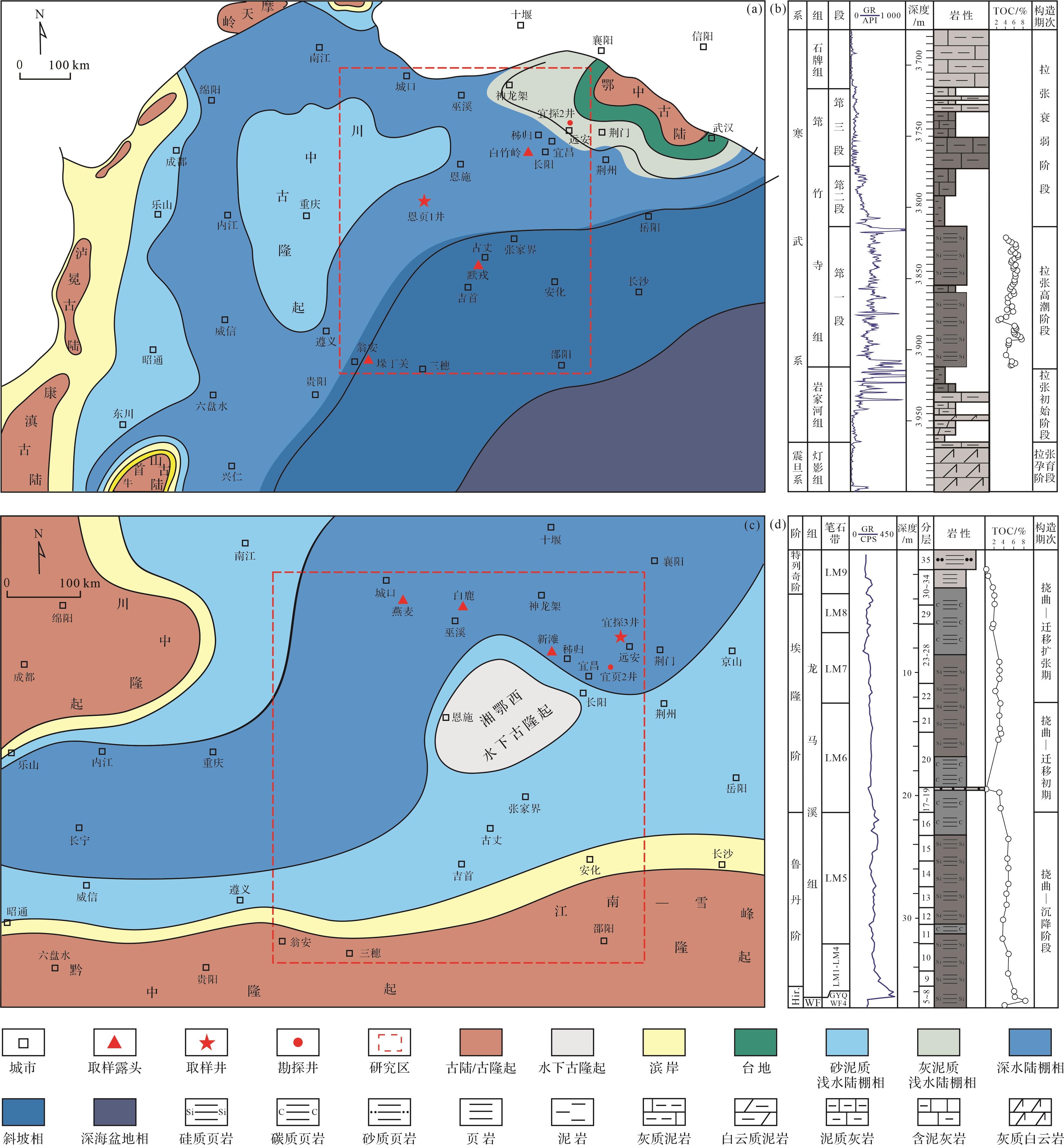
图 1 (a)中上扬子地区早寒武世筇竹寺期岩相古地理图(据文献[22]修改);(b)研究区筇竹寺组地层柱状图(来自恩页1井,构造期次划分参考文献[30]);(c)中上扬子地区早志留世龙马溪期岩相古地理图(据文献[14]修改);(d)研究区龙马溪组地层柱状图(来自燕麦剖面)
Figure 1. (a) Map showing the lithofacies paleogeography of the early Cambrian Qiongzhusi period in the Middle and Upper Yangtze region (modified from reference [22]); (b) stratigraphic column of the Qiongzhusi Formation in the study area (from well Enye1, modified from reference [30]); (c) lithofacies paleogeography of the Early Silurian Longmaxi period in the Middle and Upper Yangtze region (modified from reference [14]); (d) stratigraphic column of the Longmaxi Formation in the study area (from the Yanmai outcrop)
 下载: