
Advanced Search
Volume 43 Issue 6
Dec.  2025
Turn off MathJax
Article Contents

CHEN Yang, JIN Xin, LANG XianGuo, LI BinBing. Sulfur Cycle Change and Its Geological Significance During the Toarcian Oceanic Anoxic Event (T⁃OAE) in the Ordos Basin[J]. Acta Sedimentologica Sinica, 2025, 43(6): 1952-1967. doi: DOI:10.14027/j.issn.1000-0550.2023.112
Citation: CHEN Yang, JIN Xin, LANG XianGuo, LI BinBing. Sulfur Cycle Change and Its Geological Significance During the Toarcian Oceanic Anoxic Event (T⁃OAE) in the Ordos Basin[J]. Acta Sedimentologica Sinica, 2025, 43(6): 1952-1967. doi: DOI:10.14027/j.issn.1000-0550.2023.112

Sulfur Cycle Change and Its Geological Significance During the Toarcian Oceanic Anoxic Event (T⁃OAE) in the Ordos Basin

doi: DOI:10.14027/j.issn.1000-0550.2023.112
  • Received Date: 2023-08-22
  • Accepted Date: 2023-11-30
  • Rev Recd Date: 2023-11-01
  • Available Online: 2023-11-30
  • Publish Date: 2025-12-10
  • Objective At present, research on the Early Jurassic Toarcian Oceanic Anoxic Event (T-OAE; ~183 Ma) in the Ordos Basin primarily emphasizes paleoclimate conditions, the evolution of the sedimentary environment, and biodiversity changes. However, the mechanisms governing sulfur cycling in lakes during the T-OAE remain unclear. Consequently, further examination of the sulfur cycling mechanism is essential. Methods Twenty-eight samples were selected from the Anya section. Mineralogy and isotope geochemistry analyses were performed on mudstone and black shale samples from the Anya section. The mechanisms of sulfur isotope fractionation during the T-OAE were investigated using major and trace elements, as well as pyrite sulfur isotopes (δ34Spy). To avoid interference from marcasite and siderite, mineral morphology and energy spectra were examined using a scanning electron microscope (SEM). Results The pyrite in the samples from the Anya section predominantly were tetrahedral and octahedral crystals, forming framboidal pyrite. The mineral surface exhibits a smooth texture without the presence of platy marcasite. The coexistence of radial siderite with pyrite is also observable. The δ34Spy values of these samples consistently display positive values, ranging from 2.7‰ to 14.1‰, with an average of 8.3‰. By analyzing the fluctuations in δ34Spy and total organic carbon (TOC), along with the use of geochemical indicators such as δ13C, total sulfur (TS), Corg/P, and (La/Yb)N, we delineated the evolution of the lacustrine sedimentary environment during the T-OAE into four distinct stages, comprising periods characterized by high (Stages I and II) and low organic matter (Stages I and II). Conclusions The δ34Spy values during the T-OAE in the Anya section of the Ordos Basin align with those of atmospheric precipitation and surface runoff, suggesting that sulfate in the water mass serves as the primary source of sulfur in the lake. Atmospheric precipitation and surface runoff mainly consist of dissolved sulfate ions exhibiting lacustrine sulfate isotope compositions between 0 and 10%. However, the samples from the Anya section include black shale, mudstone, sandstone, and other low sulfur source rocks, likely resulting in smaller sulfur isotope compositions within the lakes. It is improbable that the sulfur isotope composition of pyrite is inherited from lacustrine sulfate. The sulfur isotopes in the pyrite of the samples are primarily influenced by the redox conditions of the lake bottom water and the organic matter content/type within the sediment. When the lake bottom water is oxygen-rich and the organic matter content is low, dissolved oxygen infiltrates into sediments, activating anaerobic oxidants such as NO2- and Mn2+, while promoting H2S reoxidation. This process leads to a positive δ34Spy shift, as described by the Rayleigh fractionation model. In contrast, when the lake bottom water is oxygen-deficient and the organic matter content high, sulfate-reducing bacteria become more active, promoting the microbial sulfate reduction (MSR) reaction, which preferentially incorporates 32S, which results in a negative δ34Spy shift. During the T-OAE, the lake redox conditions and climate underwent significant changes, exerting a substantial influence on the form, content, and fractionation of sulfur within lake. The sulfur cycle during the T-OAE in the Anya section is predominantly dictated by local and regional sedimentary environments, although it is also affected by global warming and intensified hydrological circulation during the T-OAE.
  • [1] Jenkyns H C. The Early Toarcian (Jurassic) anoxic event; stratigraphic, sedimentary and geochemical evidence[J]. American Journal of Science, 1988, 288(2): 101-151.
    [2] Bailey T R, Rosenthal Y, McArthur J M, et al. Paleoceanographic changes of the Late Pliensbachian–Early Toarcian interval: A possible link to the genesis of an Oceanic Anoxic Event[J]. Earth and Planetary Science Letters, 2003, 212(3/4): 307-320.
    [3] Them T R, Gill B C, Caruthers A H, et al. Thallium isotopes reveal protracted anoxia during the Toarcian (Early Jurassic) associated with volcanism, carbon burial, and mass extinction[J]. Proceedings of the National Academy of Sciences of the United States of America, 2018, 115(26): 6596-6601.
    [4] Dera G, Pucéat E, Pellenard P, et al. Water mass exchange and variations in seawater temperature in the NW Tethys during the Early Jurassic: Evidence from neodymium and oxygen isotopes of fish teeth and belemnites[J]. Earth and Planetary Science Letters, 2009, 286(1/2): 198-207.
    [5] Pieńkowski G, Hodbod M, Ullmann C V. Fungal decomposition of terrestrial organic matter accelerated Early Jurassic climate warming[J]. Scientific Reports, 2016, 6(1): 31930.
    [6] Pálfy J, Smith P L. Synchrony between Early Jurassic extinction, oceanic anoxic event, and the Karoo-Ferrar flood basalt volcanism[J]. Geology, 2000, 28(8): 747-750.
    [7] Hesselbo S P, Gröcke D R, Jenkyns H C, et al. Massive dissociation of gas hydrate during a Jurassic Oceanic Anoxic Event[J]. Nature, 2000, 406(6794): 392-395.
    [8] Xu W M, Ruhl M, Jenkyns H C, et al. Carbon sequestration in an expanded lake system during the Toarcian Oceanic Anoxic Event[J]. Nature Geoscience, 2017, 10(2): 129-134.
    [9] Liu M, Sun P, Them II T R, et al. Organic geochemistry of a lacustrine shale across the Toarcian Oceanic Anoxic Event (Early Jurassic) from NE China[J]. Global and Planetary Change, 2020, 191: 103214.
    [10] Lu J, Zhou K, Yang M F, et al. Terrestrial organic carbon isotopic composition (δ 13Corg) and environmental perturbations linked to Early Jurassic volcanism: Evidence from the Qinghai-Tibet Plateau of China[J]. Global and Planetary Change, 2020, 195: 103331.
    [11] Jin X, Shi Z Q, Baranyi V, et al. The Jenkyns event (Early Toarcian OAE) in the Ordos Basin, North China[J]. Global and Planetary Change, 2020, 193: 103273.
    [12] Jin X, Zhang F, Baranyi V, et al. Early Jurassic massive release of terrestrial mercury linked to floral crisis[J]. Earth and Planetary Science Letters, 2022, 598: 117842.
    [13] Guillemette F, von Wachenfeldt E, Kothawala D N, et al. Preferential sequestration of terrestrial organic matter in boreal lake sediments[J]. Journal of Geophysical Research: Biogeosciences, 2017, 122(4): 863-874.
    [14] Cullers R L. The controls on the major- and trace-element evolution of shales, siltstones and sandstones of Ordovician to Tertiary age in the wet mountains region, Colorado, U.S.A.[J]. Chemical Geology, 1995, 123(1/2/3/4): 107-131.
    [15] Castañeda I S, Schouten S. A review of molecular organic proxies for examining modern and ancient lacustrine environments[J]. Quaternary Science Reviews, 2011, 30(21/22): 2851-2891.
    [16] Li B B, Jin X, Corso J D, et al. Complex pattern of environmental changes and organic matter preservation in the NE Ordos lacustrine depositional system (China) during the T-OAE (Early Jurassic)[J]. Global and Planetary Change, 2023, 221: 104045.
    [17] Yan D T, Chen D Z, Wang Q C, et al. Predominance of stratified anoxic Yangtze Sea interrupted by short-term oxygenation during the Ordo-Silurian transition[J]. Chemical Geology, 2012, 291: 69-78.
    [18] Wei H Y, Wei X M, Qiu Z, et al. Redox conditions across the G-L boundary in South China: Evidence from pyrite morphology and sulfur isotopic compositions[J]. Chemical Geology, 2016, 440: 1-14.
    [19] Liu A Q, Tang D J, Shi X Y, et al. Growth mechanisms and environmental implications of carbonate concretions from the ~1.4 Ga Xiamaling Formation, North China[J]. Journal of Palaeogeography, 2019, 8: 20.
    [20] Liu Q Y, Zhu D Y, Jin Z J, et al. Influence of volcanic activities on redox chemistry changes linked to the enhancement of the ancient Sinian source rocks in the Yangtze Craton[J]. Precambrian Research, 2019, 327: 1-13.
    [21] 王春连,刘成林,徐海明,等. 湖北江陵凹陷古新统沙市组四段硫酸盐硫同位素组成及其地质意义[J]. 吉林大学学报(地球科学版),2013,43(3):691-703.

    Wang Chunlian, Liu Chenglin, Xu Haiming, et al. Sulfur isotopic composition of sulfate and its geological significance of member 4 of Palaeocene Shashi Formation in Jiangling Depression of Hubei province[J]. Journal of Jilin University (Earth Science Edition), 2013, 43(3): 691-703.
    [22] 宋柳霆,刘丛强,王中良,等. 贵州红枫湖硫酸盐来源及循环过程的硫同位素地球化学研究[J]. 地球化学,2008,37(6):556-564.

    Song Liuting, Liu Congqiang, Wang Zhongliang, et al. Stable sulfur isotopic geochemistry to investigate potential sources and cycling behavior of sulfate in Lake Hongfeng, Guizhou province[J]. Geochimica, 2008, 37(6): 556-564.
    [23] Ke C W, Li S M, Greenwood P, et al. Maturity and depositional controls on compound-specific sulfur isotope values of saline lacustrine source rocks in the north Dongpu Depression, Bohai Bay Basin[J]. Journal of Petroleum Science and Engineering, 2022, 212: 110286.
    [24] 史忠生,陈开远,史军,等. 东濮盐湖古近系硫酸盐硫同位素组成及地质意义[J]. 石油勘探与开发,2004,31(6):44-46.

    Shi Zhongsheng, Chen Kaiyuan, Shi Jun, et al. Sulfur isotopic composition and its geological significance of the Paleogene sulfate rock deposited in Dongpu Depression[J]. Petroleum Exploration and Development, 2004, 31(6):44-46.
    [25] Lowenstein T K, Timofeeff M N, Kovalevych V M, et al. The major-ion composition of Permian seawater[J]. Geochimica et Cosmochimica Acta, 2005, 69(7): 1701-1719.
    [26] Zerkle A L, Kamyshny Jr A, Kump L R, et al. Sulfur cycling in a stratified euxinic lake with moderately high sulfate: Constraints from quadruple S isotopes[J]. Geochimica et Cosmochimica Acta, 2010, 74(17): 4953-4970.
    [27] Johnston D T. Multiple sulfur isotopes and the evolution of Earth’s surface sulfur cycle[J]. Earth-Science Reviews, 2011, 106(1/2): 161-183.
    [28] Wang N, Li M J, Hong H T, et al. Biological sources of sedimentary organic matter in Neoproterozoic–lower Cambrian shales in the Sichuan Basin (SW China): Evidence from biomarkers and microfossils[J]. Palaeogeography, Palaeoclimatology, Palaeoecology, 2019, 516: 342-353.
    [29] Pang Y M, Guo X W, Shi B B, et al. Hydrocarbon generation evaluation, burial history, and thermal maturity of the Lower Triassic-Silurian organic-rich sedimentary rocks in the central uplift of the South Yellow Sea Basin, East Asia[J]. Energy & Fuels, 2020, 34(4): 4565-4578.
    [30] Berner R A, Raiswell R. Burial of organic carbon and pyrite sulfur in sediments over Phanerozoic time: A new theory[J]. Geochimica et Cosmochimica Acta, 1983, 47(5): 855-862.
    [31] Berner R A. Sedimentary pyrite formation: An update[J]. Geochimica et Cosmochimica Acta, 1984, 48(4): 605-615.
    [32] Chen G, Chang X C, Gang W Z, et al. Anomalous positive pyrite sulfur isotope in lacustrine black shale of the Yanchang Formation, Ordos Basin: Triggered by paleoredox chemistry changes[J]. Marine and Petroleum Geology, 2020, 121: 104587.
    [33] Tuttle M L, Rice C A, Goldhaber M B. Geochemistry of organic and inorganic sulfur in ancient and modern lacustrine environments: Case studies of freshwater and saline lakes[M]//Orr W L, White C M. Geochemistry of sulfur in fossil fuels. Washington: American Chemical Society, 1990: 114-148.
    [34] Cao H S, Kaufman A J, Shan X L, et al. Sulfur isotope constraints on marine transgression in the lacustrine Upper Cretaceous Songliao Basin, northeastern China[J]. Palaeogeography, Palaeoclimatology, Palaeoecology, 2016, 451: 152-163.
    [35] Ding X D, Li D W, Zheng L W, et al. Sulfur geochemistry of a lacustrine record from Taiwan reveals enhanced marine aerosol input during the Early Holocene[J]. Scientific Reports, 2016, 6: 38989.
    [36] Brumsack H J. Inorganic geochemistry of the German ‘Posidonia Shale’: Palaeoenvironmental consequences[M]//Tyson R V, Pearson T H. Modern and ancient continental shelf anoxia. London: Geological Society, Special Publications, 1991: 353-362.
    [37] Ebli O, Vető I, Lobitzer H, et al. Primary productivity and early diagenesis in the Toarcian Tethys on the example of the Mn-rich black shales of the Sachrang Formation, northern Calcareous Alps[J]. Organic Geochemistry, 1998, 29(5/6/7): 1635-1647.
    [38] Gill B C, Lyons T W, Jenkyns H C. A global perturbation to the sulfur cycle during the Toarcian Oceanic Anoxic Event[J]. Earth and Planetary Science Letters, 2011, 312(3/4): 484-496.
    [39] Han Z, Hu X M, He T C, et al. Early Jurassic long-term oceanic sulfur-cycle perturbations in the Tibetan Himalaya[J]. Earth and Planetary Science Letters, 2022, 578: 117261.
    [40] Liu S, Yang S. Upper Triassic–Jurassic sequence stratigraphy and its structural controls in the western Ordos Basin, China[J]. Basin Research, 2000, 12(1): 1-18.
    [41] 何自新. 鄂尔多斯盆地演化与油气[M]. 北京:石油工业出版社,2003:66-83.

    He Zixin. Evolution and hydrocarbon in Ordos Basin[M]. Beijing: Petroleum Industry Press, 2003: 66-83.
    [42] 刘池洋,赵红格,王锋,等. 鄂尔多斯盆地西缘(部)中生代构造属性[J]. 地质学报,2005,79(6):737-747.

    Liu Chiyang, Zhao Hongge, Wang Feng, et al. Attributes of the Mesozoic structure on the west margin of the Ordos Basin[J]. Acta Geologica Sinica, 2005, 79(6): 737-747.
    [43] 赵俊兴,陈洪德,张锦泉. 鄂尔多斯盆地下侏罗统富县组沉积体系及古地理[J]. 岩相古地理,1999,19(5):40-46.

    Zhao Junxing, Chen Hongde, Zhang Jinquan. The depositional systems and palaeogeography of the Lower Jurassic Fuxian Formation in the Ordos Basin[J]. Sedimentary Facies and Palaeogeography, 1999, 19(5): 40-46.
    [44] 杨俊杰. 鄂尔多斯盆地构造演化与油气分布规律[M]. 北京:石油工业出版社,2002:228.

    Yang Junjie. Tectonic evolution and oil-gas reservoirs distribution in Ordos Basin[M]. Beijing: Petroleum Industry Press, 2002: 228.
    [45] 葛道凯,杨起,付泽明,等. 陕西榆林侏罗纪煤系基底古侵蚀面的地貌特征及其对富县组沉积作用的控制[J]. 沉积学报,1991,9(3):65-73.

    Ge Daokai, Yang Qi, Fu Zeming, et al. The palaeornorphologic features of the basement of the Jurassic coal measures and its control on the sedimentation of Fuxian Formation in Yulin, Shaanxi[J]. Acta Sedimentologica Sinica, 1991, 9(3): 65-73.
    [46] 冯云鹤. 鄂尔多斯盆地(内蒙古部分)富县组的发现及其意义[J]. 地层学杂志,2014,38(4):449-453.

    Feng Yunhe. The discovery of the Fuxian Formation in the Ordos Basin (Inner Mongolia part) and its implications[J]. Journal of Stratigraphy, 2014, 38(4): 449-453.
    [47] 朱广社. 鄂尔多斯盆地晚三叠世—中侏罗世碎屑岩、沉积、层序充填过程及其成藏效应[D]. 成都:成都理工大学,2014.

    Zhu Guangshe. Sedimentary, sequence filling process and its accumulation effect of Late Triassic to Middle Jurassic in Ordos Basin[D]. Chengdu: Chengdu University of Technology, 2014.
    [48] 杨华,席胜利,魏新善,等. 鄂尔多斯多旋回叠合盆地演化与天然气富集[J]. 中国石油勘探,2006,11(1):17-24.

    Yang Hua, Xi Shengli, Wei Xinshan, et al. Evolution and natural gas enrichment of multicycle superimposed basin in Ordos Basin[J]. China Petroleum Exploration, 2006, 11(1): 17-24.
    [49] 李昌昊,葛禹,金鑫,等. 鄂尔多斯盆地早侏罗世富县期沉积演化:大洋缺氧事件前后陆地气候变化的响应[J]. 古地理学报,2022,24(4):697-712.

    Li Changhao, Ge Yu, Jin Xin, et al. Sedimentological evolution during the Early Jurassic Fuxian period in Ordos Basin: Palaeoclimatic response to Toarcian Oceanic Anoxic Event[J]. Journal of Palaeogeography, 2022, 24(4): 697-712.
    [50] 贾本文. 鄂尔多斯盆地东南部侏罗系延安组延10物源分析[D]. 西安:长安大学,2020.

    Jia Benwen. Provenance analysis of Yan 10 in Yan'an Formation of Jurassic in the southeast of Ordos Basin[D]. Xi’an: Chang'an University, 2020.
    [51] 张云望,金鑫,乔培军,等. 鄂尔多斯盆地东北部下侏罗统富县组沉积物源分析:来自榆林安崖剖面砂岩的岩石学及元素地球化学证据[J]. 沉积学报,2023,41(5):1414-1429.

    Zhang Yunwang, Jin Xin, Qiao Peijun, et al. Petrological and geochemical constraints on sedimentary provenance of the Fuxian Formation (Lower Jurassic) sandstones in the northeastern Ordos Basin[J]. Acta Sedimentologica Sinica, 2023, 41(5): 1414-1429.
    [52] 葛道凯,杨起,付泽明,等. 陕北榆林富县组中的遗迹化石及其环境意义[J]. 煤田地质与勘探,1989,17(6):1-3.

    Ge Daokai, Yang Qi, Fu Zeming, et al. The trace fossils and depositional environments of Fuxian Formation, Yulin county, northern Shaanxi province[J]. Coal Geology & Exploration, 1989, 17(6): 1-3.
    [53] Baranyi V, Jin X, Dal Corso J, et al. Collapse of terrestrial ecosystems linked to heavy metal poisoning during the Toarcian Oceanic Anoxic Event[J]. Geology, 2023, 51(7): 652-656.
    [54] Canfield D E, Raiswell R, Westrich J T, et al. The use of chromium reduction in the analysis of reduced inorganic sulfur in sediments and shales[J]. Chemical Geology, 1986, 54(1/2): 149-155.
    [55] Wilkin R T, Barnes H L, Brantley S L. The size distribution of framboidal pyrite in modern sediments: An indicator of redox conditions[J]. Geochimica et Cosmochimica Acta, 1996, 60(20): 3897-3912.
    [56] Canfield D E. Biogeochemistry of sulfur isotopes[J]. Reviews in Mineralogy and Geochemistry, 2001, 43(1): 607-636.
    [57] Taylor S R, McLennan S M. The geochemical evolution of the continental crust[J]. Reviews of Geophysics, 1995, 33(2): 241-265.
    [58] Owens J D, Lyons T W, Li X N, et al. Iron isotope and trace metal records of iron cycling in the proto-North Atlantic during the Cenomanian-Turonian Oceanic Anoxic Event (OAE-2)[J]. Paleoceanography, 2012, 27(3): PA3223.
    [59] Jenkyns H C. Geochemistry of oceanic anoxic events[J]. Geochemistry, Geophysics, Geosystems, 2010, 11(3): Q03004.
    [60] Kaplan I R, Rittenberg S C. Microbiological fractionation of sulphur isotopes[J]. Journal of General Microbiology, 1964, 34(2): 195-212.
    [61] Ryu J H, Zierenberg R A, Dahlgren R A, et al. Sulfur biogeochemistry and isotopic fractionation in shallow groundwater and sediments of Owens Dry Lake, California[J]. Chemical Geology, 2006, 229(4): 257-272.
    [62] Nara F W, Watanabe T, Kakegawa T, et al. Climate control of sulfate influx to Lake Hovsgol, northwest Mongolia, during the last glacial–postglacial transition: Constraints from sulfur geochemistry[J]. Palaeogeography, Palaeoclimatology, Palaeoecology, 2010, 298(3/4): 278-285.
    [63] Algeo T J, Shen Y A, Zhang T G, et al. Association of 34S-depleted pyrite layers with negative carbonate δ 13C excursions at the Permian-Triassic boundary: Evidence for upwelling of sulfidic deep-ocean water masses[J]. Geochemistry, Geophysics, Geosystems, 2008, 9(4): Q04025.
    [64] Huang Y J, Yang G S, Gu J, et al. Marine incursion events in the Late Cretaceous Songliao Basin: Constraints from sulfur geochemistry records[J]. Palaeogeography, Palaeoclimatology, Palaeoecology, 2013, 385: 152-161.
    [65] 常鑫,张明宇,谷玉,等. 黄、东海陆架泥质区自生黄铁矿成因及其控制因素[J]. 地球科学进展,2020,35(12):1306-1320.

    Chang Xin, Zhang Mingyu, Gu Yu, et al. Formation mechanism and controlling factors of authigenic pyrite in mudsediments on the shelf of the Yellow Sea and the East China Sea[J]. Advances in Earth Science, 2020, 35(12): 1306-1320.
    [66] 张生. 碳、硫同位素储库效应的定量理论模式[J]. 地质论评,1997,43(2):174-180.

    Zhang Sheng. Theoretical models of reservoir effects on carbon and sulfur isotopes[J]. Geological Review, 1997, 43(2): 174-180.
    [67] Jiang K X, Lin C M, Zhang X, et al. Storm-driven variations in depositional environments modify pyrite sulfur isotope records[J]. Earth and Planetary Science Letters, 2023, 610: 118118.
    [68] Tenger, Liu W H, Xu Y C, et al. Comprehensive geochemical identification of highly evolved marine hydrocarbon source rocks: Organic matter, paleoenvironment and development of effective hydrocarbon source rocks[J]. Chinese Journal of Geochemistry, 2006, 25(4): 333-340.
    [69] 袁伟,柳广弟,罗文斌. 鄂尔多斯盆地延长组长7段沉积速率及其对烃源岩有机质丰度的影响[J]. 西安石油大学学报(自然科学版),2016,31(5):20-26.

    Yuan Wei, Liu Guangdi, Luo Wenbin. Deposition rate of the Seventh member of Yangchang Formation, Ordos Basin and its impact on organic matter abundance of hydrocarbon source rock[J]. Journal of Xi'an Shiyou University (Natural Science Edition), 2016, 31(5): 20-26.
    [70] Habicht K S, Gade M, Thamdrup B, et al. Calibration of sulfate levels in the Archean Ocean[J]. Science, 2002, 298(5602): 2372-2374.
    [71] Bradley A S, Leavitt W D, Schmidt M, et al. Patterns of sulfur isotope fractionation during microbial sulfate reduction[J]. Geobiology, 2016, 14(1): 91-101.
    [72] Lang X G, Shen B, Peng Y B, et al. Transient marine euxinia at the end of the terminal Cryogenian glaciation[J]. Nature Communications, 2018, 9(1): 3019.
    [73] Cao H S, He W T, Chen F J, et al. Integrated chemostratigraphy (δ 13C-δ 34S-δ 15N) constrains Cretaceous lacustrine anoxic events triggered by marine sulfate input[J]. Chemical Geology, 2021, 559: 119912.
    [74] Canfield D E. Isotope fractionation by natural populations of sulfate-reducing bacteria[J]. Geochimica et Cosmochimica Acta, 2001, 65(7): 1117-1124.
    [75] Lang X G, Tang W B, Ma H R, et al. Local environmental variation obscures the interpretation of pyrite sulfur isotope records[J]. Earth and Planetary Science Letters, 2020, 533: 116056.
    [76] Algeo T J, Ingall E. Sedimentary Corg: P ratios, paleocean ventilation, and Phanerozoic atmospheric pO2 [J]. Palaeogeography, Palaeoclimatology, Palaeoecology, 2007, 256(3/4): 130-155.
    [77] Canfield D E, Thamdrup B. Towards a consistent classification scheme for geochemical environments, or, why we wish the term “suboxic” would go away[J]. Geobiology, 2009, 7(4): 385-392.
    [78] Fry B, Ruf W, Gest H, et al. Sulfur isotope effects associated with oxidation of sulfide by O2 in aqueous solution[J]. Chemical Geology: Isotope Geoscience section, 1988, 73(3): 205-210.
    [79] Ries J B, Fike D A, Pratt L M, et al. Superheavy pyrite (δ 34Spyr > δ 34SCAS) in the terminal Proterozoic Nama Group, southern Namibia: A consequence of low seawater sulfate at the dawn of animal life[J]. Geology, 2009, 37(8): 743-746.
    [80] Adams D D, Hurtgen M T, Sageman B B. Volcanic triggering of a biogeochemical cascade during Oceanic Anoxic Event 2[J]. Nature Geoscience, 2010, 3(3): 201-204.
    [81] Boetius A, Ravenschlag K, Schubert C J, et al. A marine microbial consortium apparently mediating anaerobic oxidation of methane[J]. Nature, 2000, 407(6804): 623-626.
    [82] 聂应. 南羌塘Toarcian大洋缺氧事件期间的古环境研究[D]. 成都:成都理工大学,2021.

    Nie Ying. A study on the paleo-environment during the Toarcian Oceanic Anoxic Event in the southern Qiangtang[D]. Chengdu: Chengdu University of Technology, 2021.
  • 加载中
通讯作者: 陈斌, bchen63@163.com
  • 1. 

    沈阳化工大学材料科学与工程学院 沈阳 110142

  1. 本站搜索
  2. 百度学术搜索
  3. 万方数据库搜索
  4. CNKI搜索

Figures(8)  / Tables(1)

Article Metrics

Article views(16) PDF downloads(5) Cited by()

Proportional views
Related
Publishing history
  • Received:  2023-08-22
  • Revised:  2023-11-01
  • Accepted:  2023-11-30
  • Published:  2025-12-10

Sulfur Cycle Change and Its Geological Significance During the Toarcian Oceanic Anoxic Event (T⁃OAE) in the Ordos Basin

doi: DOI:10.14027/j.issn.1000-0550.2023.112

Abstract: Objective At present, research on the Early Jurassic Toarcian Oceanic Anoxic Event (T-OAE; ~183 Ma) in the Ordos Basin primarily emphasizes paleoclimate conditions, the evolution of the sedimentary environment, and biodiversity changes. However, the mechanisms governing sulfur cycling in lakes during the T-OAE remain unclear. Consequently, further examination of the sulfur cycling mechanism is essential. Methods Twenty-eight samples were selected from the Anya section. Mineralogy and isotope geochemistry analyses were performed on mudstone and black shale samples from the Anya section. The mechanisms of sulfur isotope fractionation during the T-OAE were investigated using major and trace elements, as well as pyrite sulfur isotopes (δ34Spy). To avoid interference from marcasite and siderite, mineral morphology and energy spectra were examined using a scanning electron microscope (SEM). Results The pyrite in the samples from the Anya section predominantly were tetrahedral and octahedral crystals, forming framboidal pyrite. The mineral surface exhibits a smooth texture without the presence of platy marcasite. The coexistence of radial siderite with pyrite is also observable. The δ34Spy values of these samples consistently display positive values, ranging from 2.7‰ to 14.1‰, with an average of 8.3‰. By analyzing the fluctuations in δ34Spy and total organic carbon (TOC), along with the use of geochemical indicators such as δ13C, total sulfur (TS), Corg/P, and (La/Yb)N, we delineated the evolution of the lacustrine sedimentary environment during the T-OAE into four distinct stages, comprising periods characterized by high (Stages I and II) and low organic matter (Stages I and II). Conclusions The δ34Spy values during the T-OAE in the Anya section of the Ordos Basin align with those of atmospheric precipitation and surface runoff, suggesting that sulfate in the water mass serves as the primary source of sulfur in the lake. Atmospheric precipitation and surface runoff mainly consist of dissolved sulfate ions exhibiting lacustrine sulfate isotope compositions between 0 and 10%. However, the samples from the Anya section include black shale, mudstone, sandstone, and other low sulfur source rocks, likely resulting in smaller sulfur isotope compositions within the lakes. It is improbable that the sulfur isotope composition of pyrite is inherited from lacustrine sulfate. The sulfur isotopes in the pyrite of the samples are primarily influenced by the redox conditions of the lake bottom water and the organic matter content/type within the sediment. When the lake bottom water is oxygen-rich and the organic matter content is low, dissolved oxygen infiltrates into sediments, activating anaerobic oxidants such as NO2- and Mn2+, while promoting H2S reoxidation. This process leads to a positive δ34Spy shift, as described by the Rayleigh fractionation model. In contrast, when the lake bottom water is oxygen-deficient and the organic matter content high, sulfate-reducing bacteria become more active, promoting the microbial sulfate reduction (MSR) reaction, which preferentially incorporates 32S, which results in a negative δ34Spy shift. During the T-OAE, the lake redox conditions and climate underwent significant changes, exerting a substantial influence on the form, content, and fractionation of sulfur within lake. The sulfur cycle during the T-OAE in the Anya section is predominantly dictated by local and regional sedimentary environments, although it is also affected by global warming and intensified hydrological circulation during the T-OAE.

CHEN Yang, JIN Xin, LANG XianGuo, LI BinBing. Sulfur Cycle Change and Its Geological Significance During the Toarcian Oceanic Anoxic Event (T⁃OAE) in the Ordos Basin[J]. Acta Sedimentologica Sinica, 2025, 43(6): 1952-1967. doi: DOI:10.14027/j.issn.1000-0550.2023.112
Citation: CHEN Yang, JIN Xin, LANG XianGuo, LI BinBing. Sulfur Cycle Change and Its Geological Significance During the Toarcian Oceanic Anoxic Event (T⁃OAE) in the Ordos Basin[J]. Acta Sedimentologica Sinica, 2025, 43(6): 1952-1967. doi: DOI:10.14027/j.issn.1000-0550.2023.112
  • 早侏罗世Toarcian大洋缺氧事件(Toarcian Oceanic Anoxic Event,T-OAE;~183 Ma)是以富含有机质的黑色页岩大范围沉积[1],并伴随着显著的碳同位素负偏[1]、全球气候变暖[2]、广泛海洋缺氧[3]、水文循环加剧[4]以及生物多样性改变等为特征的全球性气候事件[5]。目前多数学者认为T-OAE时期碳同位素负偏移可能与Karoo-Ferrar大火成岩省爆发而释放的大规模CO2和CH4有关[6],也有学者认为陆地有机物大规模分解[5]与海洋沉积物或陆地甲烷水化合物的解离[7]是导致地球系统碳循环波动的原因。

    目前对T-OAE的研究主要集中在海相地层中,而对于同时代湖泊序列的研究尤其匮乏[812]。湖泊环境不仅是有机质最富集的区域之一,且其具有较强的碳储存能力,还可以作为全球碳循环中的一个重要汇[8,13]。相比于海洋,湖泊具有较高的沉积速率,能够提供大陆环境条件变化的高分辨率记录,其中湖泊沉积物所携带的各种信息,如地球化学信息和生物信息,可用于恢复陆地的古气候和古环境[1416]。湖泊环境同样也是硫循环的一个重要汇,在微生物硫酸盐还原过程中,硫酸盐和硫化物之间的循环还伴随着碳和铁的循环,因此硫同位素组成也可以用于重建沉积环境的波动[1724]

    硫元素是自然界中广泛存在的元素之一,在大气系统、海洋系统和生态系统中起着十分重要的作用。明确硫同位素分馏机制有助于提升对地质历史时期中各个过程的认识,例如硫酸盐还原,硫循环与碳循环的联系等[2529]。硫有四种稳定同位素,原子质量和常规丰度百分比分别为32S(95.02%)、33S(0.75%)、34S(4.21%)、36S(0.02%),常用[(34S/32S)样品/(34S/32S)标准-1]代表硫同位素的组成。硫循环是海洋和湖泊系统中生物地球化学的重要组成部分,并与碳和铁循环密切相关。例如在海洋中,Berner et al.[3031]探讨了有机碳与黄铁矿硫的埋藏关系,指出碳/硫(Corg/Spy)比值的变化可以反映有机碳埋藏环境的变化,并且黄铁矿硫同位素(δ34Spy)的变化还能指示有机碳的来源。Chen et al.[32]利用δ34Spy结合有机碳同位素(δ13Corg)探讨了长7段黑色页岩中黄铁矿硫的来源,并结合古氧化还原指标探讨了黑色页岩沉积过程中“重”黄铁矿的形成机制。在湖泊中,Tuttle et al.[33]列举了八个湖泊中的硫同位素变化并进行总结。在未遭受外界影响的情况下,淡水湖中硫同位素组成通常受到较低的硫酸盐含量控制,且硫同位素组成接近湖泊硫酸盐。在盐水湖中则十分复杂,盐水湖含有大量的硫酸盐,然而孔隙水中的pH、活性铁的浓度、有机质含量等都会影响硫同位素组成的变化。外界的影响通常指海侵等输入硫源的事件。Cao et al.[34]指出中国东北白垩纪松辽盆地湖泊的硫同位素受到海侵事件约束,海侵将海水中大量的硫酸盐引入湖泊,从而促进了缺氧底水中微生物硫酸盐还原,致使δ34S降低,随后海退的发生使海洋与盆地再次隔离,黄铁矿埋藏增加导致δ34S上升至30‰。Ding et al.[35]同样指出海洋气溶胶输入会对湖泊的硫同位素组成造成影响,气溶胶中含有大量富集δ34S的硫酸盐,导致湖泊中的TS和δ34S异常上升。

    迄今为止,对T-OAE期间硫循环的系统研究相对较少[3639]。Gill et al.[38]介绍了北欧陆表海三个剖面的高分辨率碳酸盐晶格硫酸盐硫同位素组成(δ34SCAS),发现δ34SCAS与碳酸盐碳同位素(δ13Ccarb)在T-OAE期间均表现出正偏移,表明硫同位素偏移能够反映全球的硫循环扰动,并提出了硫同位素的演化模型,推断有机碳和全球中深水地区陆架和斜坡沉积物中黄铁矿的埋藏速率增加导致δ34SCASδ13Ccarb出现同步正偏移,并认为在T-OAE期间黄铁矿埋藏速率增加可能是全球性的现象。Han et al.[39]研究了西藏喜马拉雅卧龙剖面的δ34SCAS变化特征,发现δ34SCASδ13Corg在Sinemurian-Pliensbachian界线和Pliensbachian后期均有一定的负相关性,认为是黄铁矿埋藏增强导致,并且在Pliensbachian开始时,硫酸盐浓度下降导致研究区对T-OAE的响应更为明显。在T-OAE事件的背景下,湖泊水体的氧化还原条件以及气候等发生了剧烈变化,这对湖泊中硫的形态、含量,以及分馏情况有着极大的影响。然而,对于T-OAE时期的湖泊硫同位素的组成特征及其与T-OAE的联系缺乏研究。

    因此,本文选取鄂尔多斯盆地东北部的安崖剖面为研究对象,综合前人对该地区T-OAE时期湖泊沉积环境重建的研究[1112,16],通过分析泥岩和页岩样品的δ34Spy和矿物学特征,并结合前人已有的主微量元素数据、TOC数据、碳同位素数据,对安崖剖面T-OAE时期湖泊黄铁矿硫同位素组成特征进行研究,重建其硫的生物地球化学循环过程,并进一步探索其与T-OAE的耦合联系。

  • 鄂尔多斯盆地是我国第二大沉积盆地,面积约37×104 km2,位于中国华北板块西部,包含有晚三叠世至早白垩世的沉积层序[4041]。其经历过多期的构造运动,属于大型多旋回内陆坳陷叠合盆地[42]。蕴藏有丰富的油气、煤炭等资源,是中国中生代地层最大的内陆含油气、煤盆地之一[4244]

    印支运动导致华北板块与华南板块汇聚使盆地整体抬升,三叠纪末期沉积作用停止并且开始遭受强烈剥蚀,形成了早侏罗世沟壑纵横的古地貌特征[45]。盆地整体均衡隆起使盆地遭受剥蚀,导致上三叠统延长组和下侏罗统富县组之间形成了广泛的假整合接触面[46]。鄂尔多斯盆地演化可分为六个阶段:基底形成于太古代—古元古代,在结晶基底形成后在“吕梁运动”时期固结;中—新元古代拗拉槽裂陷演化形成多处裂谷;早古生代陆块扩张发育,形成浅海台地;而在晚古生代克拉通再次下沉,进入坳陷演化;中生代海水逐渐退出,转化为内陆盆地;新生代周缘断陷盆地演化等[41,43-44,4748]

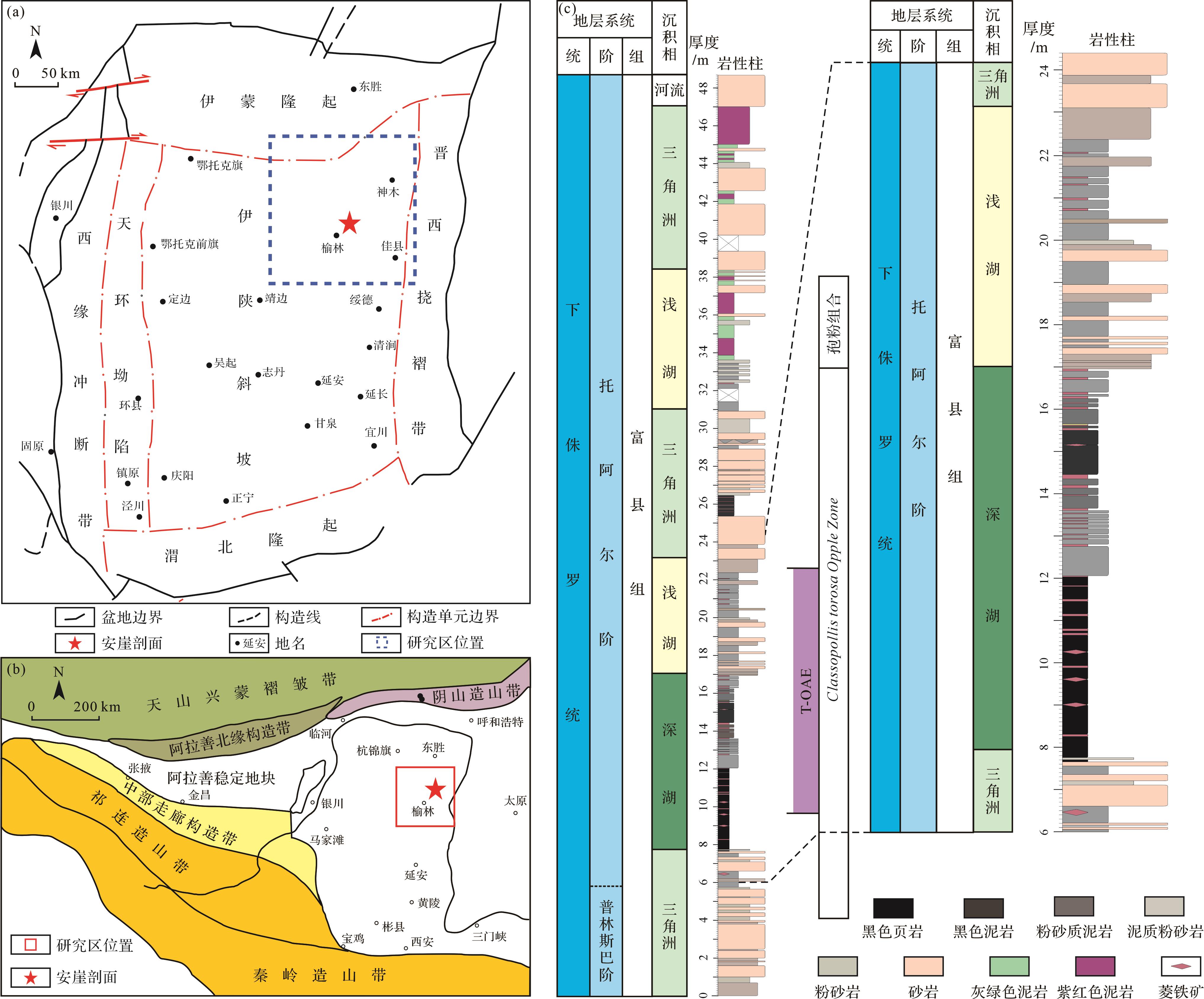
    盆地的构造依据现今可划分为北部伊盟隆起、中部伊陕斜坡、南部渭北隆起、东部晋西挠褶带及天环坳陷和相邻的西缘逆冲带六个一级构造单元[42,4950]图1a)。

    Figure 1.  Tectonic units, location, and lithology of the Anya section in the Ordos Basin

  • 安崖剖面位于鄂尔多斯盆地东北部[4950]图1b),距离榆林市约40 km。安崖剖面厚度约为48.7 m,为下侏罗统富县组,与下伏地层上三叠统延长组呈不整合接触[1112,49]。根据前人研究,剖面底部0~2.0 m为中层粉砂岩和灰白色薄层砂岩互层,2.0~4.0 m为灰色中厚层砂岩,4.0~7.8 m为灰绿色细砂岩、泥质粉砂岩和粉砂质泥岩互层。在此之上,剖面7.8~12.0 m为黑色页岩,富含带状和透镜状菱铁矿。剖面12.0~14.5 m为深灰色粉砂质泥岩,14.5~17.0 m为深灰色泥岩和粉砂质泥岩,17.0~23.0 m为杂色泥岩和灰白色薄层砂岩互层。剖面23.0~31.0 m为灰白色、灰黄色砂岩,夹薄层白色粉砂岩。在剖面31.0~38.5 m处,以杂色泥岩夹薄层砂岩为主。剖面顶部38.5~47.0 m发育紫色泥岩和中厚层灰白色砂岩,夹有灰绿色薄层泥岩,47.0 m以上发育厚层状灰白色砂岩。根据岩性组成、沉积构造和遗迹化石,将安崖剖面富县组划分为河流、三角洲、深湖及浅湖环境4个沉积相[1112,16,49,5152]图1c)。

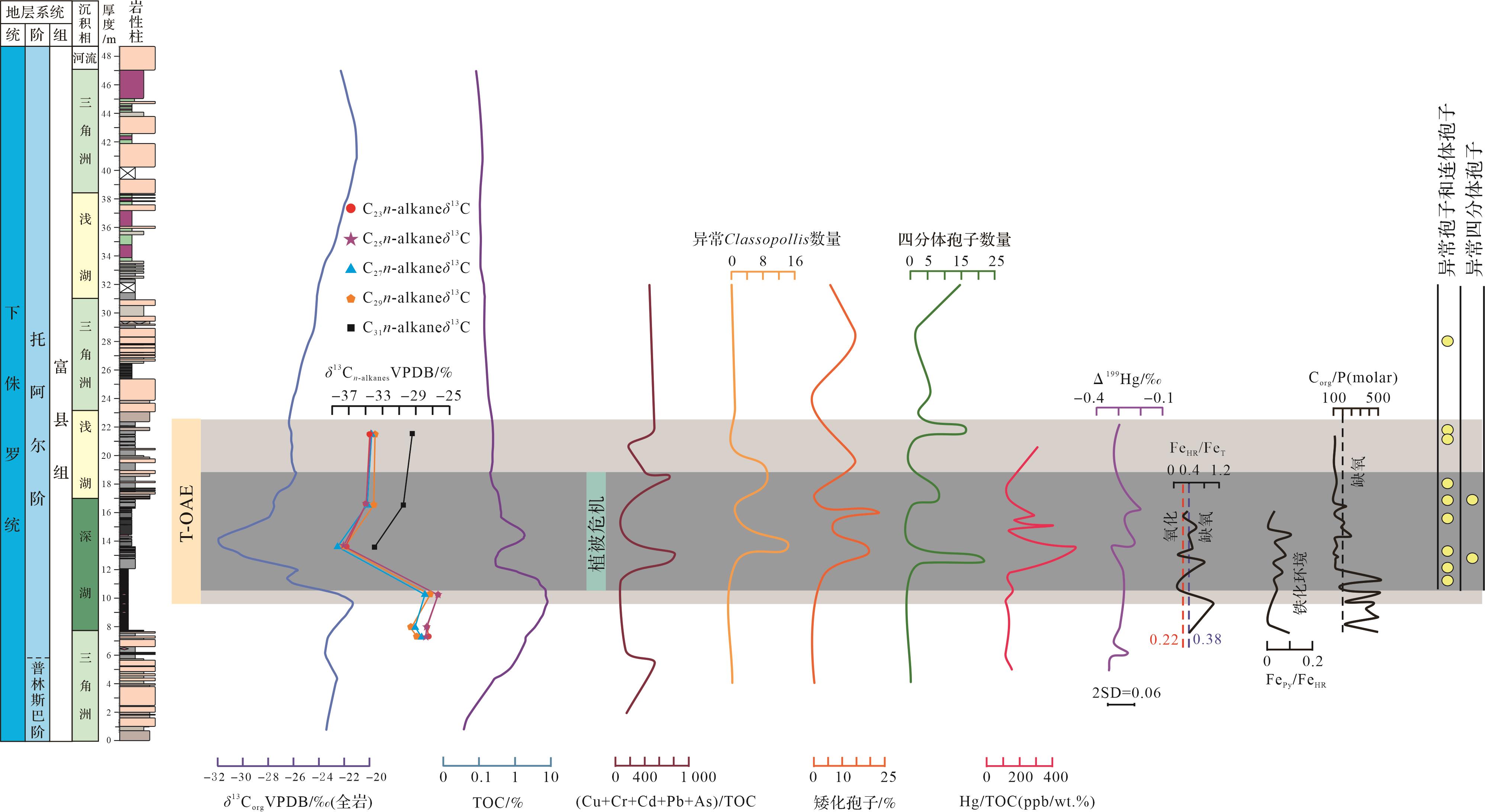
    Jin et al.[11]根据孢粉结果将安崖剖面的沉积时代限定在Pliensbachian晚期—Toarcian早期,并发现T-OAE时期Classopollis孢粉丰度的显著增加与升温和大陆风化增强相一致;全岩有机碳同位素和长链正构烷烃碳同位素研究表明,在事件发生层位分别出现~-12.5‰和~-11‰的两次碳同位素偏移,剧烈的碳同位素偏移特征可以与全球经典的T-OAE事件剖面对比,表明鄂尔多斯盆地安崖剖面很好地记录了T-OAE事件。随后Jin et al.[12]发现在该剖面T-OAE期间碳同位素负偏峰值对应的Hg元素含量高度富集且δ199Hg<0,表明湖泊Hg主要来源于陆源物质,并且主要富集在有机物质中,Hg/TOC显著增加与植物危机同步发生,进一步揭示了安崖剖面的Hg元素富集与林下植被系统的崩溃和去森林化现象有关。Li et al.[16]深入研究了该地区有机质积累的机制与T-OAE的联系,通过Corg/P和铁组分的变化,发现安崖剖面经历了多期次氧化还原条件变化。当处于缺氧环境时有机质出现大量富集,认为安崖剖面有机质的聚集是局部氧化还原条件和较高初级生产力耦合作用的结果,且与T-OAE期间的古气候和环境演化密切相关。Baranyi et al.[53]通过将安崖剖面孢粉畸形学和地球化学指标相结合,发现T-OAE植被更替时期孢粉发生畸形率(孢子矮化,不对称四分体孢子,异常孢子等)与重金属富集同步(Hg、Cu、Cr、Cd、Pb、As),并表明T-OAE期间的气候变化虽然会破坏植被的稳定性,降低植物的生存能力,但是有毒重金属含量增加才是导致孢子和花粉突变的主要原因,而且有毒重金属还能破坏陆地植物的繁殖周期,最终导致陆地生态系统崩溃。此外,张云望等[51]结合地球化学和岩石学对鄂尔多斯盆地下侏罗统物源体系进行研究,认为富县组砂岩的母岩岩性为中酸性岩浆岩及变质岩,并通过稀土元素揭示出鄂尔多斯盆地东北部富县组主要源区为阴山造山带。

    综上,前人对于鄂尔多斯盆地安崖剖面地区的研究多聚集于富县组的沉积环境、沉积相、碳循环扰动、物源体系以及T-OAE的陆相生物—环境响应等[1112,16,49,51,53]图2),未曾对安崖剖面富县组硫同位素变化进行研究。

    Figure 2.  Bioenvironmental changes during the Toarcian Oceanic Anoxic Event (T⁃OAE) in the Anya section

  • 野外采集样品为黑色页岩、黑色泥岩、粉砂岩等,采集时尽量避开风化表面以保证取得内部新鲜样品。样品分析之前先用砂纸,锉刀等工具将表面灰尘和风化面去除,再用去离子水冲洗,随后放置于55 ℃烘箱中烘干,之后用玛瑙钵将样品研磨至200目以下,最后用牛皮纸进行装袋。所有样品测试前均保存完好无污染。

  • 黄铁矿的提取参照Canfield et al.[54]建议的方法,将1~5 g样品粉末置于氮气环境下,利用铬还原法,将黄铁矿还原为硫化氢,使用银氨溶液收集H2S气体,最终得到Ag2S沉淀。在进一步的清洗、过滤和干燥后,将Ag2S沉淀物与过量的V2O5混合,并在配备有用于样品燃烧的有机元素分析仪(FLASH, 2000)的同位素比质谱仪(Delta V Advantage)上进行硫同位素组成分析。硫同位素组成相对于VCDT以‰表示,并使用四个国际标准进行校准:IAEA-S-1(Ag2S,δ34S=-0.3‰)、IAEA-S-2(Ag2S,δ34S=22.7‰),IAEA-S-3(Ag2S,δ34S=-32.06‰)和NBS-127(BaSO4δ34S=20.3‰)。分析误差小于0.2‰。黄铁矿硫的提取和同位素组成(δ34Spy)测定在中国科学院南京地质古生物研究所进行。

    从安崖剖面采集的样品中选取21个样品进行扫描电镜和能谱分析。分析之前,首先使用高精度镀膜仪给薄片表面镀碳以增强薄片导电性,从而使薄片图像更加清晰。在成都理工大学油气藏地质与开发国家重点实验室,采用场发射环境扫描电子显微镜(FEI Quanta 250 FEG, USA)与能量色散谱(EDS)进行分析。

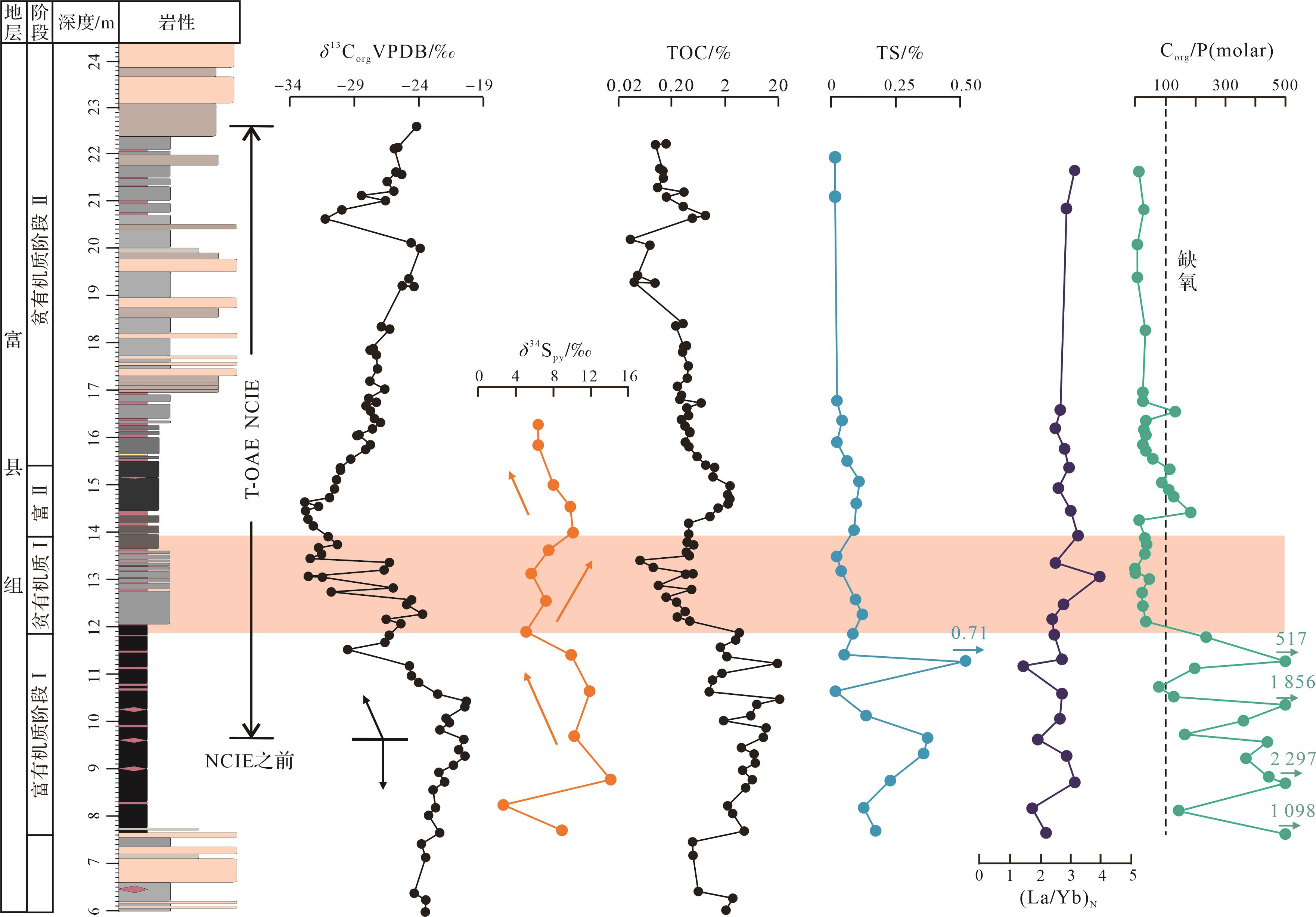
  • 选取了安崖剖面共20个样品进行黄铁矿含量和硫同位素的测试(表1),但只有15个样品含有效数据。样品的黄铁矿含量低,平均值仅有0.07%,硫同位素整体表现为正值。安崖剖面样品的δ34Spy值介于2.7‰~14.1‰,平均值为8.3‰,并且随着剖面纵向变化明显。δ34Spy首先在7.7~8.8 m出现正偏移(2.7‰~14.1‰),随后在8.8~11.8 m中转变为负偏移(14.1‰~5.1‰),之后在11.8~13.9 m再次转换为正偏移(5.1‰~10.1‰),最后在13.9~16.2 m层段呈负偏移(10.1‰~6.4‰)。因此,根据δ34Spy和TOC含量的变化(图3[1112,16]将安崖剖面研究层段划分为富有机质阶段Ⅰ(7.7~11.8 m),贫有机质阶段Ⅰ(11.8~13.9 m),富有机质阶段Ⅱ(13.9~15.3 m),贫有机质阶段Ⅱ(15.3~22.0 m)。

    深度/mδ34Spy/‰黄铁矿含量%TOC/%TS/%Al/%δ13Corg/‰Corg/P(molar)(La/Yb)N
    7.78.90.105.200.1813.46-22.381 0982.18
    8.22.70.102.900.1315.88-22.711451.73
    8.814.10.066.800.2317.26-22.002 2973.16
    9.3//7.960.3618.36/3682.88
    9.710.20.0410.100.3714.50-20.514401.94
    10.1//6.140.1418.13-21.893602.66
    10.611.90.021.100.0216.24-22.551292.72
    11.2//14.000.7116.92-24.731981.45
    11.49.90.022.600.0516.80-26.655172.72
    11.85.10.063.800.0914.95-26.292362.48
    12.2//0.670.1314.44-26.53352.40
    12.57.20.180.300.1016.01-24.95242.77
    13.15.70.030.400.0418.81-31.48473.97
    13.4//0.080.0318.66-26.28112.51
    13.67.50.11///-31.53//
    13.910.10.120.500.0917.86-31.03333.25
    14.59.80.161.600.1017.89-32.771853.01
    14.98.00.052.000.1116.90-30.541122.60
    15.3//1.000.0617.91-30.081152.95
    15.86.40.010.500.0317.53-28.12352.81
    16.26.40.050.300.0516.82-27.59292.50
    16.6**0.500.0317.77-27.731332.67
    17.5**//////
    18.1**//////
    19.1**//////
    19.4/0.04//////
    20.9//0.330.0217.20/282.88
    21.6//0.140.0217.30/123.15
    注:“*”表示未达仪器检出限,“/”表示未进行测试;表格中TOC、Al、Corg/P、TS、(La/Th)N数据引自文献[16];δ13Corg数据引自文献[11]。

    Table 1.  Geochemical data of samples in the Anya section

    Figure 3.  Changes in paleoenvironmental proxies during the T⁃OAE in the Anya section of the Ordos Basin

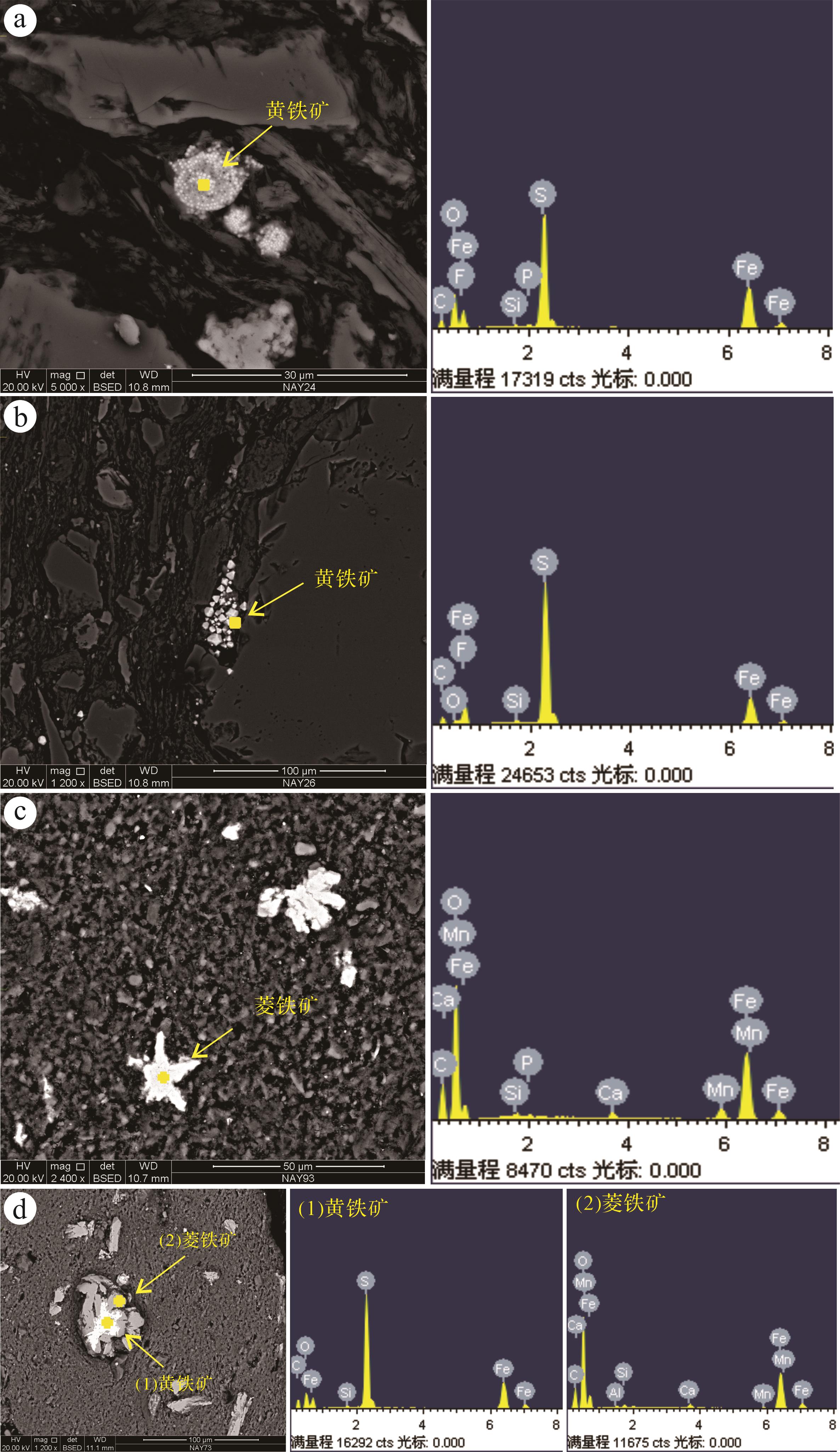
  • 通过EDS数据对比,图4a、b黄铁矿含有明显的S峰,而图4c菱铁矿没有,再根据形态学证据,安崖剖面中样品矿物颗粒形态以四面体和八面体为主,且晶体表面光滑均匀,而白铁矿镜下一般为表面粗糙的不规则状和板状,因此排除其为白铁矿。

    Figure 4.  Scanning electron microscope (SEM) images of the Anya samples

    安崖剖面样品中黄铁矿形态以草莓状集合体为主,其余还可见自形晶状、簇状集合体、放射状单晶(图4a,b)。草莓状黄铁矿直径介于5~15 μm,组成的黄铁矿晶粒形状大多为四面体和八面体。簇状集合体黄铁矿长度约50 μm,组成的晶形也多为四面体和八面体,组成晶粒直径为3~5 μm。黄铁矿与放射状(裂隙状)菱铁矿呈现共生状态,粒径为15~40 μm,中间白色为黄铁矿,周围包裹深色硅质物质和菱铁矿(图4d)。

    研究区黄铁矿含量少,在7.0~10.3 m深度范围内大多数为草莓状黄铁矿,而在10.5 m处可见自形晶黄铁矿。这一区间内草莓状黄铁矿的粒径表明产出黄铁矿的孔隙水中氧化还原环境为缺氧环境到贫氧环境[55]

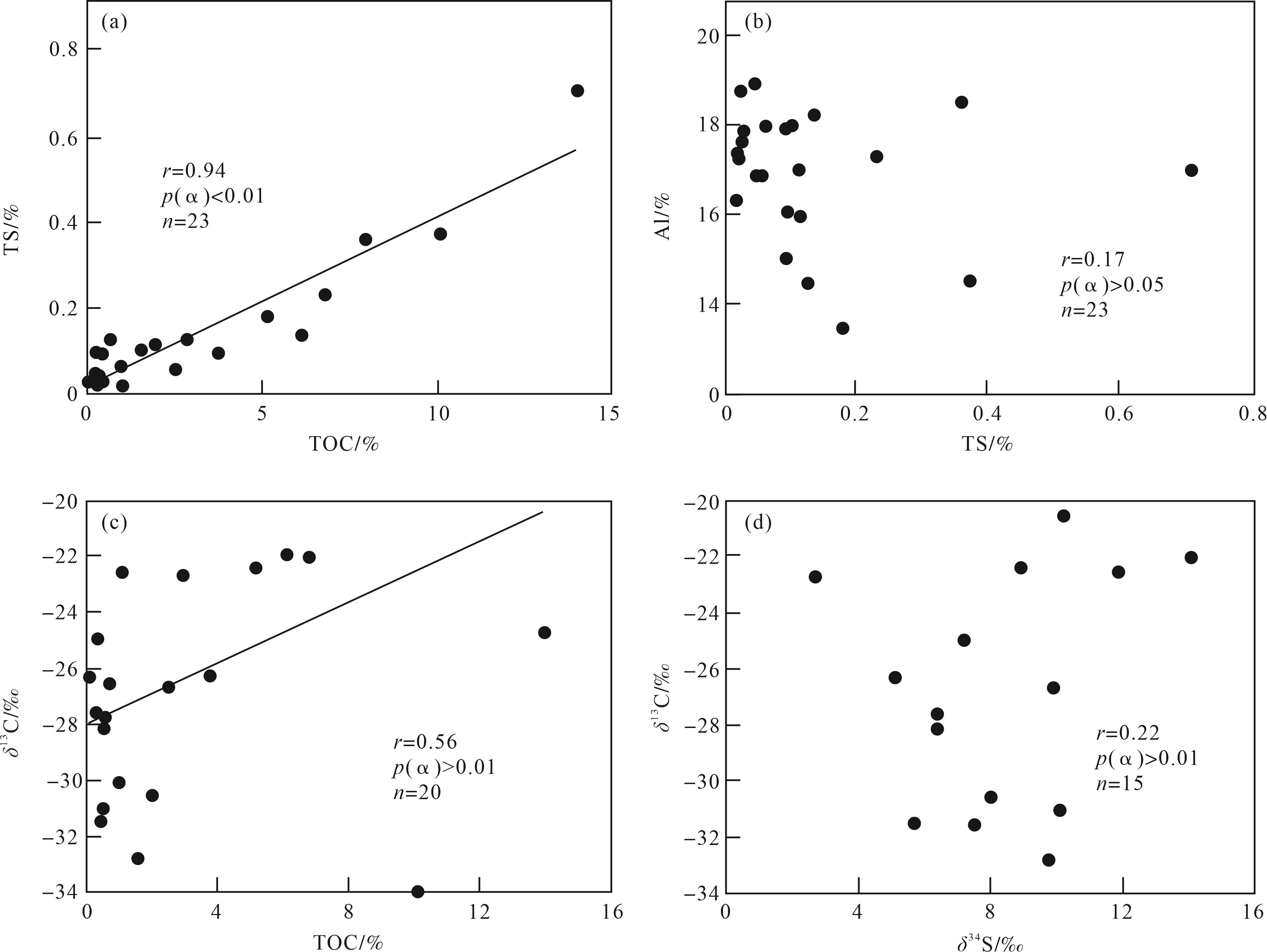
  • 湖泊中硫的各种来源一般包括:大气降水和地表径流(δ34S介于3‰~15‰)、溶解蒸发岩(δ34S介于10‰~30‰)、黄铁矿氧化(δ34S介于-40‰~5‰)和火山和热液系统(δ34S介于-10‰~15‰)[56]。在安崖剖面中,黄铁矿硫同位素的组成相比于其他湖泊研究区具有较高的δ34Spy值(2.7‰~14.1‰)。按照以上分类,安崖剖面的硫的来源可能来自大气降水和地表径流或者火山和热液系统。但热液活动的扩大可以增加沉积物中热液铁的浓度,导致FeT/Al升高且远大于大陆地壳平均值0.5[5758]。然而,安崖样品中整体的FeT/Al平均值为0.13,远小于0.5,因此排除热液活动对δ34S组成的影响。安崖剖面中总硫(TS)与TOC呈显著正相关[12,16]图5a;r=0.94,p(α)<0.01,n=23),但与Al元素的含量解耦[16]图5b;r=0.17,p(α)>0.05,n=23),这些相关性表明,安崖剖面中硫的固存在很大程度上受沉积物有机质富集的影响。

    Figure 5.  Cross plots of geochemical parameters from the Anya samples

    在黄铁矿形成过程中,成岩作用和过度生长往往会对其产生影响而使δ34Spy值受到影响[55],因此有必要对黄铁矿是否为原生黄铁矿进行评估。通过扫描电镜观察,发现黄铁矿形态以草莓状黄铁矿为主,晶形以四面体和八面体为主,晶体粒径介于5~15 μm,未发现成岩生长和过度生长的现象,表明研究区的黄铁矿主要形成于沉积物的孔隙水中,为原生黄铁矿,能够有效反映原始的湖泊沉积环境。此外,安崖剖面样品中δ34Spy高值较普遍,表明样品并未受制备或者分析带来的影响。成岩过程中的热变化会导致有机质降解,并释放出大量的含碳气体,导致δ13C降低[59],而安崖剖面样品的δ13C与TOC呈正相关[11]图5c;r=0.56,p(α)>0.01,n=20),表明δ13C变化不是成岩过程中的热变化引起[32]。此外,在成岩过程中,沉积物发生固结和压实作用,水分排出导致有机质和硫酸盐组分被浓缩,使得δ13C和δ34S趋于正相关[56,59]。安崖剖面样品中δ34Spyδ13C整体无明显相关性[11]图5d;r=0.22,p(α)>0.01,n=15),这种现象表明安崖样品δ34Spyδ13C的关系可以反映原始沉积环境[32]

  • 前人将δ34Spy异常正值的黄铁矿称为“重”黄铁矿[56]。研究表明,微生物硫酸盐还原(Microbral Sulfate Reduction,MSR)反应被认为是造成硫同位素中32S和34S分馏的关键,与同期的硫酸盐相比,MSR的还原产物(例如H2S及其衍生物)相对贫缺34S[32,56,60]。根据微生物硫酸盐还原反应机理(公式(1))[56],充足的有机碳、高硫酸盐浓度,以及底水还原环境是同生黄铁矿结晶的最适宜条件[6162];而低硫酸盐环境、MSR的还原产物再次氧化、表层水和底水的连通性等可能会抑制MSR反应活性从而产生“重”黄铁矿[32,56,6364]

    2CH2O+SO42-→H2S+2HCO3- (1)

    综上所述,同生沉积黄铁矿硫同位素组成受多方面因素的共同影响,如硫酸盐供给速率、有机质供给速率、沉积速率、氧化还原条件等。以下将通过这些方面对硫同位素进行讨论。

  • 沉积速率对黄铁矿硫同位素的影响往往通过间接改变其他限制因素来实现[65]。Liu et al.[19]对中国东部沿海平原以及东海内陆架泥质沉积物中黄铁矿进行研究,发现样品中黄铁矿硫同位素的值与沉积速率曲线有着良好的相关性,指出高沉积速率导致孔隙水与上覆海水之间的硫酸盐交换受到限制,更易形成封闭环境,从而更有效地消耗沉积物中的硫酸盐矿物。由于储库效应(Reservoir Effect,稳定硫同位素在固—液相之间的分馏作用,当含硫的矿物不断沉淀时,残余溶液总的同位素组成将发生连续和系统的变化,从而影响到晚期沉淀矿物的同位素组成,最终使早期和晚期的δ34S存在明显差异[66])和瑞利分馏作用(Rayleigh Fractionation,指在开放体系中,反应生成的产物一旦形成后,马上就从系统中分离开,从而实现同位素分馏效应的过程[67]),导致黄铁矿硫同位素变重[19]

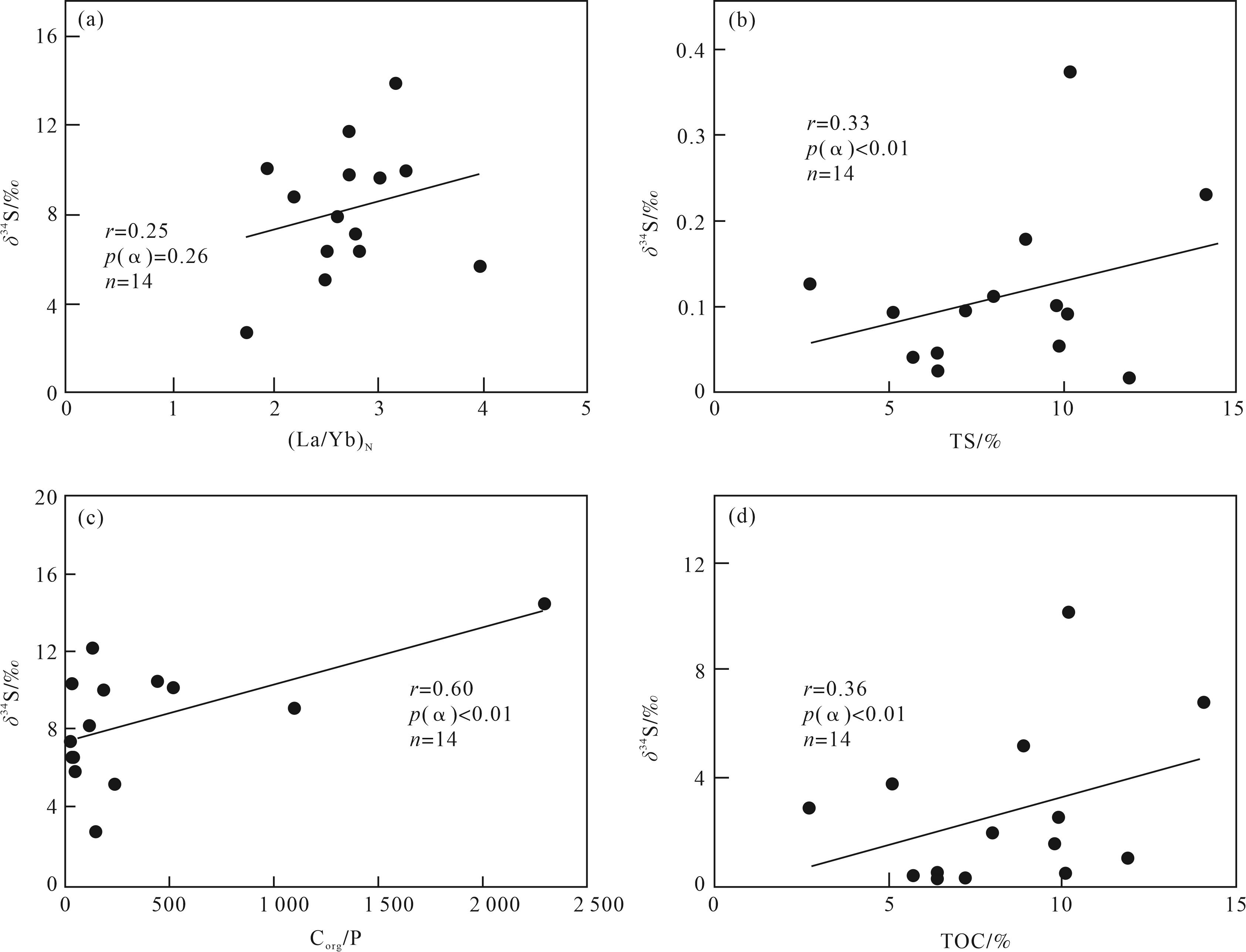
    Li et al.[16]使用轻稀土元素镧(La)和重稀土元素镱(Yb)的比值(La/Yb)N评价细粒沉积物的沉积速率。稀土元素在沉积的过程中会与细粒沉积物结合使稀土元素产生分异,轻稀土元素结合后通常会沉积下来,而重稀土元素会形成稳定的络合物留在水体。(La/Yb)N比值接近于1沉积速率越快,分异程度弱,而比值越高则越慢,且分异程度强[68]。研究剖面的(La/Yb)N比值反映T-OAE时期沉积速率整体保持恒定,其中大部分比值大于2,指示相对较低的沉积速率。沉积速率变化与该时期的沉积环境耦合(即深湖相为主),因为深湖相沉积物往往具有较低的沉积速率[69]。在沉积速率低时,孔隙水与上覆湖水之间的交互未受到影响,同时δ34Spy与(La/Yb)N之间没有相关性[16]图6a;r=0.25,p(α)=0.26,n=14),也证明了沉积速率不是影响安崖剖面δ34Spy这一观点。综上所述,研究区沉积速率不是控制δ34Spy变化的原因。

    Figure 6.  Cross plots of geochemical parameters from the Anya samples

  • 硫酸盐浓度无论在古海洋还是古湖泊中一般都是硫同位素组成变化的主要控制因素。硫同位素微生物分馏的培养实验表明,随着硫酸盐的耗尽,硫同位素效应将会减弱,意味着硫同位素分馏减弱,黄铁矿中硫同位素会逐渐富集34S[7071]。前人对自然环境中硫同位素研究表明,在有机质充足且底水为缺氧条件时,硫酸盐浓度越高,供给速率越快,则微生物硫酸盐还原反应速率越快,硫同位素分馏程度越低,衍生的硫化物的硫同位素相对偏正。而硫酸盐浓度低,且小于200 μm时,微生物选择性吸收32S的能力减弱,则会使衍生硫化物相对富集34S,使δ34Spy偏重[30,56,7273]

    总硫(Total Sulfur,TS)是指湖泊中所有硫元素的总含量(硫酸盐,硫化物等其他形式的硫)。大气降水中的硫主要来源于大气中的硫氧化物(SOx)气体(如SO2)和硫化氢(H2S)。这些气体在大气中与氧气和水反应形成硫酸(H2SO4),其中的硫以硫酸根离子(SO42-)的形式存在。地表径流中的硫主要来自降水水体和周围土壤中的溶解性硫酸盐化合物,如硫酸钠(Na2SO4)和硫酸钙(CaSO4)。这些硫酸盐在水中溶解,并以硫酸根离子(SO42-)的形式存在。总体而言,大气降水和地表径流中的硫主要以溶解的硫酸根离子形式存在,即安崖剖面TS以硫酸盐和黄铁矿为主。

    研究区安崖剖面样品的TS含量低[11,16]。通过观察TS与δ34Spy的变化可知,在富有机质阶段Ⅰ(7.7~11.8 m)内的7.7~8.8 m层段,TS含量增大,δ34Spy值也增大;而在8.8~13.9 m层段,TS含量增加,δ34Spy却减小;而之后的阶段,TS都是处于一个较低的水平,δ34Spy却有增有减,表明δ34Spy不受TS控制。同时安崖剖面中各阶段TS与δ34Spy没有相关性[16]图6b;r=0.33,p(α)>0.05,n=14),也指示硫酸盐不是控制硫同位素变化的因素。因为湖泊环境中TS的含量低,只有当增长的量足够明显才能影响微生物硫酸盐还原反应。有研究表明,当硫酸盐浓度小于2 mmol/L时,对δ34Spy影响较弱[74],或沉积盆地中有机质含量高时,δ34Spy对硫酸盐浓度也不敏感[75]

  • Chen et al.[32]通过氧化还原敏感元素(V/Cr,U/Th)和有机碳与磷的比值(Corg/P)判断了鄂尔多斯盆地长7段底水氧化条件的变化对黄铁矿硫同位素的影响。氧化环境有利于磷的保存但不利于有机碳的保存,而缺氧环境有利于沉积物中磷的再循环,因此Corg/P比值与底层水的氧化还原状态密切相关,利用该比值可以重建海相、海陆过渡相和湖相等不同沉积环境的氧化还原条件[76]。在缺氧条件下,Corg/P比值一般大于100,峰值大于1 000;而在有氧条件下,该比值小于100,最低值小于10[76]。当底水为还原环境时,多数氧化剂(NO3-、MnO2、FeOOH)被还原,向上扩散的富34S的H2S与活性铁形成富集34S的黄铁矿[64]。底水含氧时,水体中的溶解氧渗透到沉积物中,MSR产生的H2S大部分被再次氧化,通过瑞利分馏使残余硫化物富34S。

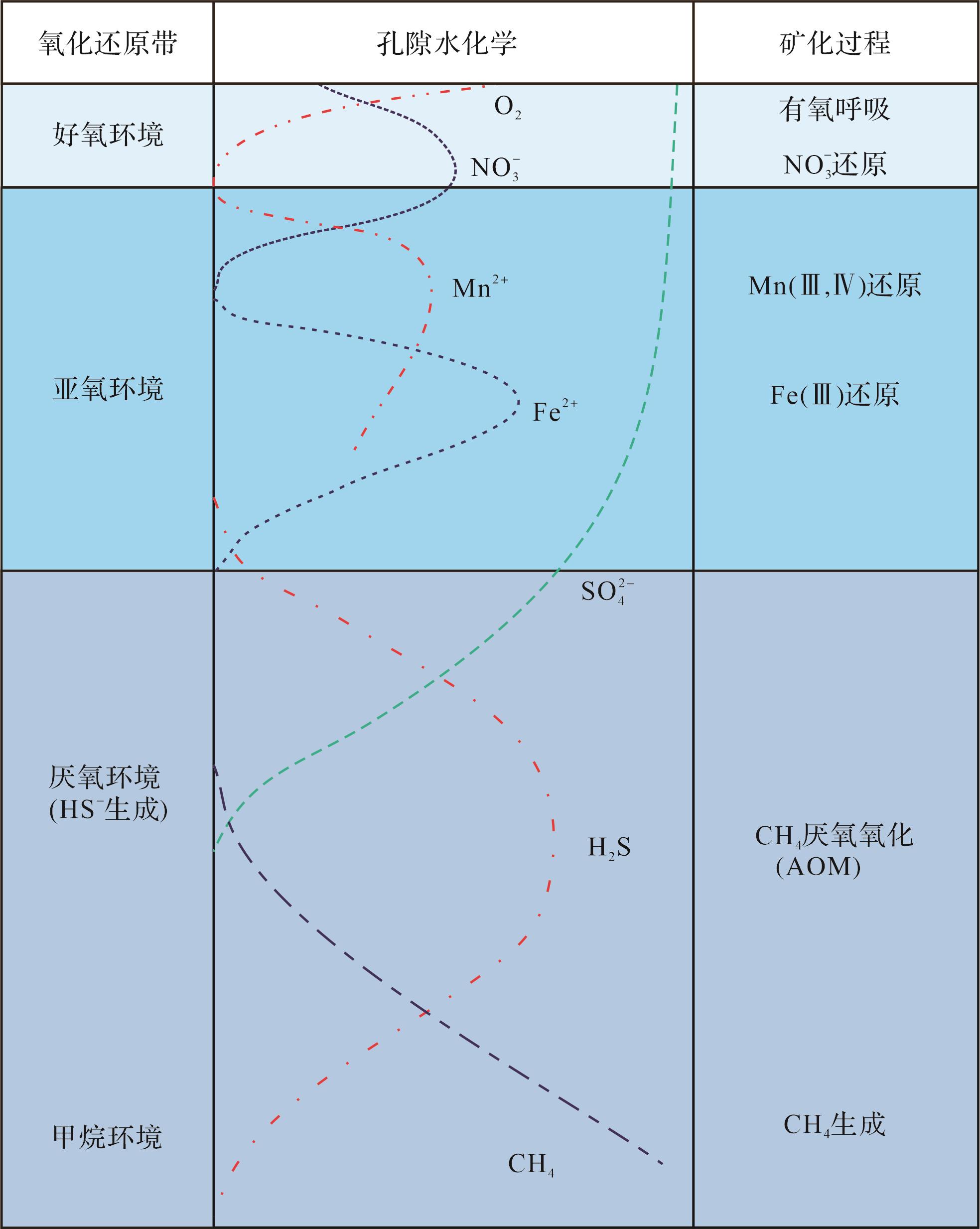
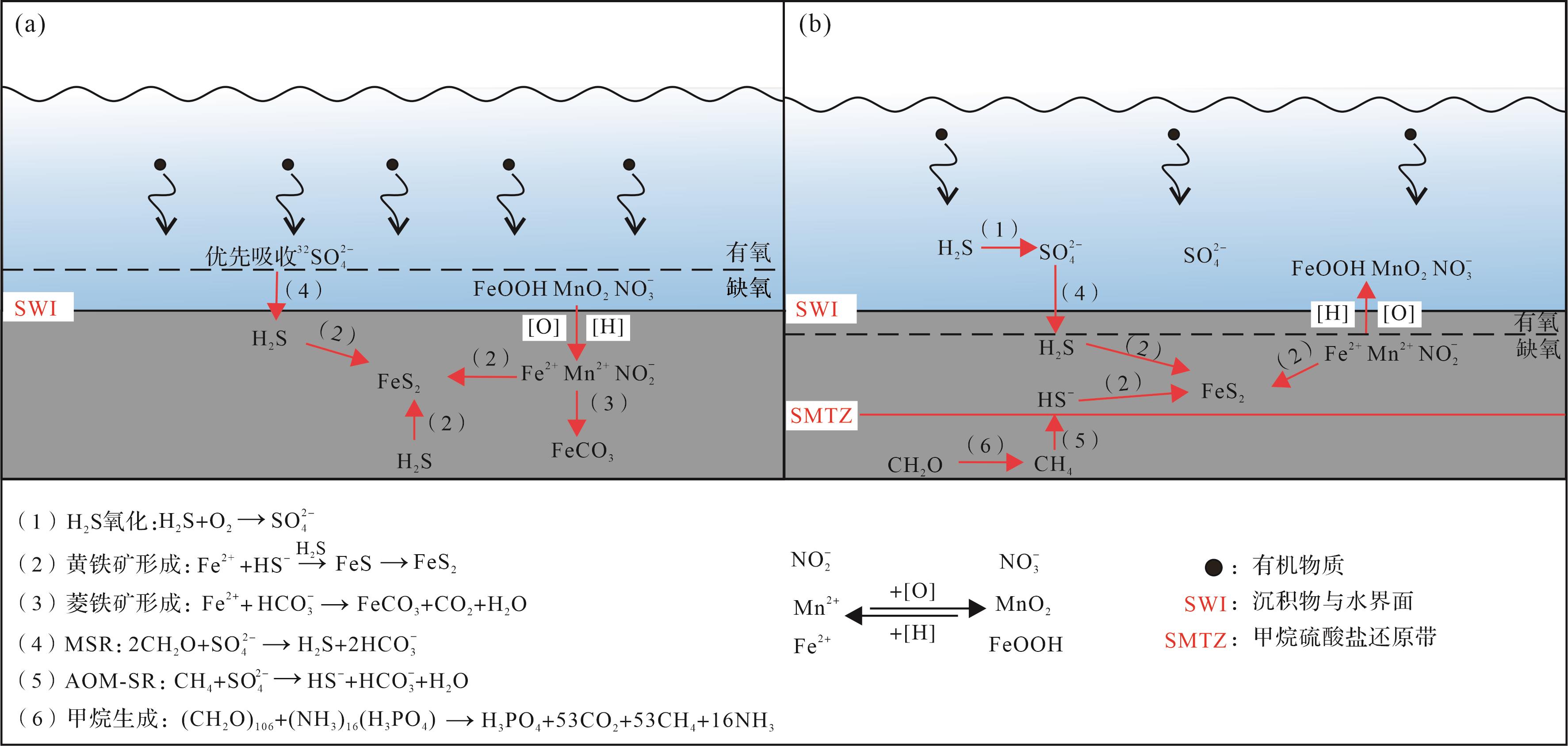
    富有机质阶段Ⅰ(7.7~11.8 m)的Corg/P比值较高(>100),表明底水处于缺氧状态(图3)。底水溶解氧稀缺,导致氧化还原界面位于沉积物—水界面上方。因此,MSR可能发生在孔隙水中,也可能发生在深层湖泊水柱中[32]。该阶段的δ34Spy整体较低(8.9‰~5.1‰),且TOC含量和TS含量波动明显,TOC和TS的峰值也出现在这个阶段,分别为14%和0.71%。在有机质充足,硫酸盐浓度相对较高,底水缺氧环境的条件下会促进MSR反应,硫酸盐还原细菌活性增强,优先吸收32S,产生富集32S的H2S,从而形成富含32S的硫化物,使得δ34Spy呈现负偏的趋势[56]。在贫有机质阶段Ⅰ(11.8~13.9 m),Corg/P比值显著下降(<50),底水向氧化环境转变(图3)。在该区间内,氧化还原界面位于沉积物—水界面下方,MSR主要发生在更深的缺氧孔隙水中,这可能导致硫酸盐供给受到限制,无法及时补充32S[32,56]。相对较低的TOC和TS含量以及底水氧化条件抑制了MSR反应的活性[56],同时低TOC也是对缺氧向氧化环境转变的响应。在该阶段样品中观察到的δ34Spy值较高(5.1‰~10.1‰)。氧化还原界面位于沉积物—水界面下方,水体中的溶解氧渗透到沉积物中发生反应[19]图7),导致孔隙水中NO2-、Mn2+和Fe2+的再次氧化形成氧化剂[77]。由于氧化剂(NO3-、MnO2、FeOOH等)的形成,MSR衍生的H2S大部分被再氧化,并通过瑞利分馏使残余硫化物中的34S富集4.0‰~5.0‰,从而形成富集34S的黄铁矿[7879]。富有机质阶段Ⅱ(13.9~15.3 m)的δ34Spy呈负偏趋势(10.1‰~8.0‰),在该阶段出现了氧化还原条件更替。底水为还原条件,高TOC再次促进MSR反应的进行,使得硫同位素组成负偏。贫有机质阶段Ⅱ(15.3~22.0 m),底水再次转化为氧化条件,氧气渗透到沉积物中使厌氧氧化剂活化,导致H2S重新氧化,富集了34S的H2S消耗,使得32S的H2S相对富集,导致黄铁矿中δ34Spy出现负偏(8.0‰~6.4‰)。同时,研究区Corg/P与δ34Spy呈正相关[16]图6c;r=0.60,p(α)<0.01,n=14),表明δ34Spy的变化受古氧化还原条件的控制。综上所述,Corg、N、Fe与δ34Spy变化有着紧密的联系,安崖剖面湖泊底水的氧化条件变化有效地控制着δ34Spy值的变化。

    Figure 7.  Redox zoning in pore water of marine sediments during early diagenesis (modified from reference [19])

  • 在湖泊和海洋体系中,有机质的埋藏和降解对氮、磷、铁、硫等元素的循环起到了重要作用。Han et al.[39]在西藏卧龙剖面中提出,在T-OAE期间海洋中溶解氧水平降低,从而导致海洋中有机物降解减少,有机质埋藏通量增加使得黄铁矿埋藏增强,最终导致海洋δ34SCAS值增大。同时,有机质的埋藏和降解调节了磷的再循环,使得T-OAE期间能够维持高水平的初级生产力和缺氧条件,有利于MSR反应的进行[16,80]。安崖剖面中TOC与δ34Spy呈弱正相关性[16]图6d;r=0.36,p(α)<0.01,n=14),表明安崖剖面有机质含量可能是影响样品的34Spy值的因素。安崖剖面富有机质阶段Ⅰ(7.7~11.8 m)含有较高的TOC含量(平均值为6.0%),且富含Ⅱ型干酪根,表明有机质的来源主要为湖泊藻类[16]。同时富有机质阶段Ⅰ的样品δ34Spy值较高(平均值为8.9‰),总体呈负偏趋势(8.9‰~5.1‰)。充足的有机质,使得MSR反应得到促进从而使硫同位素分馏明显,并且安崖剖面属于低硫酸盐浓度体系,充足的有机质和活性铁更倾向于形成菱铁矿,与这一阶段大量存在的菱铁矿相吻合[1112,16]。贫有机质阶段Ⅰ(11.8~13.9 m)样品的TOC含量较低(平均值为0.4%)且δ34Spy出现正偏(5.1‰~10.1‰)。MSR反应被抑制从而使硫同位素分馏情况变化,造成δ34Spy出现正偏,并且有机质主要富含高等植物来源的Ⅲ型干酪根[16]。由于Ⅲ型干酪根形成的有机质难分解便被保存下来,从而经历深层次活性较强的甲烷细菌的产甲烷作用。而稳定不变的沉积速率导致甲烷硫酸盐还原带(SMTZ)长期处于一个位置,产甲烷带产生的甲烷向上层扩散至SMTZ带,进行甲烷硫酸盐还原反应[65](AOM-SR,公式2[81]),使得δ34Spy正偏。

    CH4+SO42-→HS-+HCO3-+H2O (2)

    同时,反应生成的H2S容易扩散至氧化带从而被氧化,造成残留的H2S富含34S,从而形成富34S的黄铁矿,但也不能排除底层与上覆水体的广泛扩散交换导致[82]。在高有机质阶段Ⅱ(13.9~15.3 m),缺氧环境的短暂回归以及有机质含量的增加,再次促进MSR反应导致硫同位素分馏使δ34Spy呈负偏趋势。然而在低有机质阶段Ⅱ(15.3~22.0 m)时,缺氧环境很快转换为含氧环境,δ34Spy却保持负偏趋势,此时有机质不再是控制其变化因素。

  • 在T-OAE期间,鄂尔多斯盆地内的湖相沉积物中,硫同位素与碳同位素的变化情况与前人在其他剖面硫同位素变化有所不同。各阶段对应于T-OAE事件阶段如图3所示,富有机质阶段Ⅰ包含碳同位素值负偏(Negative Carbon Isotope Excursion,NCIE)之前和NCIE的起始阶段(9.7~11.8 m),该阶段的δ34Spy值介于7.7‰~5.1‰,TOC含量较高(平均值为6.0%),底水为缺氧环境。贫有机质阶段Ⅰ基本对应于NCIE中碳同位素负偏最明显的阶段(图3中的粉色方框),该阶段的δ34Spy值介于5.1‰~10.1‰,TOC含量低(平均值为0.4%),底水为氧化环境。富有机质阶段Ⅱ为剖面13.9~15.3 m处,该阶段的δ34Spy值介于10.1‰~8.0‰,TOC含量高(平均值为1.2%),缺氧环境短暂回归。贫有机质阶段Ⅱ出现在剖面的15.3~22.0 m,该阶段的δ34Spy值介于8.0‰~6.4‰,TOC较低(平均值为0.3%),底水为氧化环境。研究表明T-OAE时期δ34Spy的变化与氧化还原条件和有机质含量相关,高TOC与底水缺氧时,MSR反应得到促进,硫同位素分馏明显导致δ34Spy负偏,低TOC与底水富氧时,MSR反应被抑制且H2S被氧化,导致δ34Spy正偏(图8)。此外,安崖剖面T-OAE时期湖泊底水的缺氧环境为沉积物有机质的富集提供了充足的有机质来源和适宜的保存条件,而在缺氧条件下,有机物降解产生的磷释放到水中从而加强磷的循环利用,又维持了底水的缺氧环境[16]

    Figure 8.  Model of sulfur isotope changes in the Anya section during the Toarcian

    综上,有机质富集及氧化还原条件共同控制了鄂尔多斯盆地硫循环,而T-OAE时期气候变暖和水文循环加剧等因素为鄂尔多斯盆地有机质富集和氧化还原条件频繁更替提供了有利条件。

  • (1) 安崖剖面δ34Spy值为2.7‰~14.1‰,与大气降水和地表径流的硫同位素组成相似,指示其硫来源为大气降水和地表径流的硫酸盐,不受热液系统的干扰。

    (2) 安崖剖面中硫同位素变化的主要控制因素为氧化还原条件和有机质含量/类型,受沉积速率和硫酸盐浓度的影响较小。

    (3) 有机质富集与氧化还原条件共同调控了鄂尔多斯盆地的硫循环过程。当有机质含量较高、湖泊底水缺氧时,硫同位素分馏作用增强,导致δ34Spy出现负偏;反之,当有机质含量较低、底水富氧时,溶解氧可渗透至沉积物中,激活厌氧氧化剂,促进微生物硫酸盐还原(MSR)产生的H₂S再氧化,导致残留的H₂S硫同位素趋向于正值,从而使δ34Spy正偏,而T-OAE事件为硫循环贡献了这种频繁变化的氧化还原条件和有机质富集环境。


Reference (82)

Catalog

    /

    DownLoad:  Full-Size Img  PowerPoint
    Return
    Return